


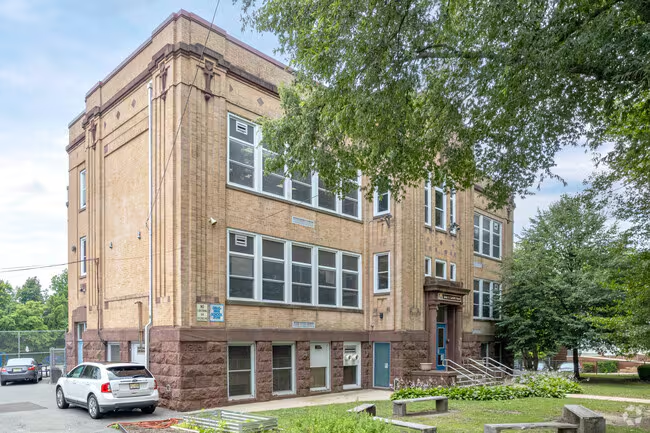

A profound financial reckoning is unfolding in Collingswood, New Jersey, where district leaders have announced a sweeping plan to close Garfield Elementary School while implementing staff reductions and program cuts in response to a $4.6 million budget shortfall. The decision marks a defining moment for the borough’s education system, reflecting not only immediate fiscal pressures but also years of structural imbalance that have steadily narrowed the district’s financial flexibility.
At the center of this crisis is a convergence of economic realities that have been building over more than a decade. District officials point to sustained increases in operational costs, reductions in federal funding streams, declining student enrollment, and ongoing shifts in New Jersey’s state aid formula as key drivers of the current deficit. Together, these forces have created a financial environment that leadership describes as unsustainable, leaving few options beyond significant structural changes.
The closure of Garfield Elementary represents one of the most visible and consequential components of the district’s response. For families and educators, the decision carries both logistical and emotional weight, as students will be reassigned and school communities reshaped. Beyond the immediate impact on those directly connected to Garfield, the move signals a broader recalibration of how educational resources are distributed across the district.
District leadership has acknowledged that these measures are not the result of a sudden downturn but rather the culmination of long-standing fiscal challenges. Collingswood Schools have operated with a structural budget deficit for approximately 13 years, a condition that has required repeated adjustments and short-term solutions. Compounding this issue, the state has indicated that for 17 years the district has relied on a below-adequate level of locally derived funding to support its operations, further limiting its ability to stabilize finances through traditional means.
The implications extend well beyond budgetary line items. Staffing reductions and program cuts inevitably affect the quality and scope of educational offerings, raising concerns among parents, educators, and community stakeholders about how to maintain academic excellence in a constrained environment. Extracurricular programs, specialized services, and classroom resources are all subject to reevaluation as the district works to align expenditures with available funding.
This situation also reflects broader trends within New Jersey’s education landscape, where districts across the state are navigating a complex interplay of funding formulas, demographic shifts, and rising costs. The evolving nature of state aid calculations has introduced new variables into local budgeting processes, often creating disparities between what districts receive and what they require to meet student needs. For communities like Collingswood, these changes have amplified existing vulnerabilities, accelerating the need for decisive action.
At the same time, declining enrollment has emerged as a significant factor in the district’s financial equation. Fewer students can translate into reduced funding allocations, while many fixed costs remain unchanged. This imbalance places additional strain on budgets, forcing districts to make difficult decisions about resource allocation and infrastructure utilization. The closure of an elementary school, while challenging, is often viewed as a necessary step in aligning facilities with current enrollment realities.
The conversation surrounding these changes is not occurring in isolation. Across the state, education leaders are increasingly focused on sustainability, equity, and long-term planning as they navigate similar challenges. The evolving coverage within the education sector highlights how districts are rethinking traditional models to adapt to new financial and demographic conditions. Collingswood’s situation serves as a case study in the complexities of balancing fiscal responsibility with the commitment to provide high-quality education.
Community response is expected to play a critical role in shaping the path forward. Public meetings, stakeholder engagement, and ongoing dialogue between district officials and residents will be essential in navigating the transition. Transparency and communication are key as families seek clarity on how changes will affect their children’s educational experience and what measures will be taken to preserve continuity and support.
Despite the challenges, district leadership has emphasized a commitment to maintaining educational standards and supporting students through the transition. Strategic planning efforts are focused on optimizing remaining resources, enhancing operational efficiency, and identifying opportunities to strengthen programs within the constraints of the new budget framework. The goal is not only to address the immediate deficit but also to establish a more sustainable financial model for the future.
The broader significance of this moment lies in what it reveals about the evolving realities of public education in New Jersey. Financial pressures are reshaping how districts operate, prompting a shift toward more adaptive, data-driven decision-making. While the closure of a school and the reduction of programs are difficult steps, they also reflect an effort to confront underlying issues directly rather than defer them further.
As Collingswood moves through this period of transition, the outcomes will likely influence conversations in other districts facing similar challenges. The balance between fiscal discipline and educational quality remains a central tension, one that requires careful navigation and a willingness to make difficult choices in pursuit of long-term stability.
In the months ahead, the focus will remain on implementation—how effectively the district can execute its plan while minimizing disruption and maintaining trust within the community. For students, families, and educators, the priority is clear: ensuring that despite the financial constraints, the core mission of education remains strong, resilient, and forward-looking in a rapidly changing environment.