


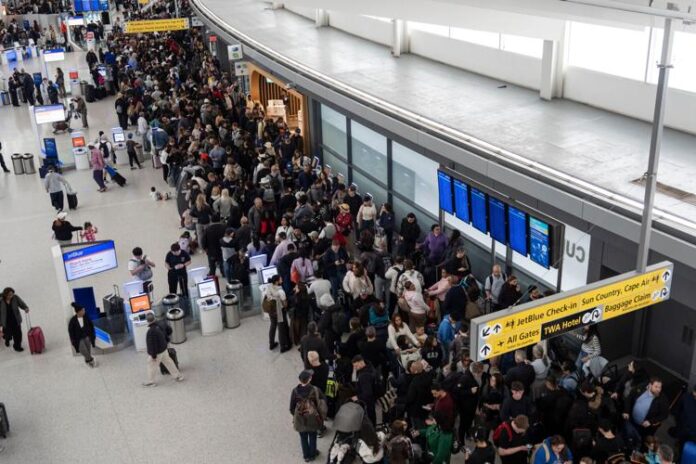

A new flashpoint in the evolving relationship between federal immigration enforcement and state governance is emerging in New Jersey, where officials are raising sharp concerns over a proposed plan to deploy Immigration and Customs Enforcement agents at major airports, including Newark Liberty International Airport. The proposal, tied to reported staffing shortages within the Transportation Security Administration, has triggered a forceful response from state leadership, reframing what might otherwise be viewed as a logistical adjustment into a broader confrontation over jurisdiction, training standards, and the role of federal agencies in civilian travel environments.
At the center of the issue is a federal initiative that would expand the presence of ICE personnel into airport operations traditionally managed by TSA agents. The stated objective is to address operational gaps and maintain security efficiency amid staffing challenges. However, New Jersey officials are making it clear that such a move cannot be treated as a simple substitution of personnel. Instead, they are emphasizing the need for clearly defined authority, specialized training, and strict adherence to protocols that distinguish airport security functions from immigration enforcement activities.
Governor Mikie Sherrill has emerged as a leading voice in this debate, characterizing the proposal as emblematic of what she describes as a broader pattern of federal overreach and operational instability. Her administration’s position is grounded in a central concern: that introducing ICE agents into airport screening or security-adjacent roles without clear guardrails could blur the lines between transportation security and immigration enforcement, creating confusion for travelers and raising potential civil liberties issues.
Newark Liberty International Airport, as one of the busiest transportation hubs in the region and a critical gateway for both domestic and international travel, represents a particularly sensitive environment for such changes. The airport serves millions of passengers annually and operates within a complex framework that balances security, efficiency, and passenger rights. Any shift in personnel or operational structure has immediate and far-reaching implications, not only for travelers but also for airline operations, federal-state coordination, and public perception of safety.
State officials are not opposing federal involvement outright; rather, they are demanding clarity and accountability. The insistence that any ICE presence must be accompanied by appropriate training underscores a broader concern about role alignment. TSA agents are specifically trained in screening procedures, threat detection, and passenger management within the unique context of airport security. ICE agents, by contrast, are primarily focused on immigration enforcement, investigations, and detention operations. While both operate under the umbrella of federal law enforcement, their mandates, training, and operational priorities differ significantly.
The potential overlap between these roles raises practical and legal questions. How would ICE agents be integrated into existing TSA workflows? What authority would they exercise in interactions with travelers? How would passenger data and screening outcomes be managed? These are not abstract considerations—they are operational realities that must be addressed to prevent disruptions, ensure compliance with established procedures, and maintain public trust.
Beyond the immediate operational concerns, the proposal is unfolding within a broader political and legislative context that has defined New Jersey’s approach to immigration and law enforcement in recent years. The state has positioned itself as a leader in establishing boundaries between local governance and federal immigration enforcement, implementing policies that prioritize community trust and limit the extent of cooperation in certain contexts. These policies are rooted in the belief that public safety is strengthened when residents feel secure engaging with local institutions without fear of immigration-related consequences.
The introduction of ICE agents into airport environments challenges that framework, bringing federal enforcement into a highly visible, high-traffic setting that intersects directly with the daily lives of residents and visitors. For state leaders, the concern is not only about policy consistency but also about the message such a deployment sends to the public. Airports are spaces where efficiency, predictability, and a sense of neutrality are essential. Any perception that these environments are being used for expanded enforcement activities could alter traveler behavior and erode confidence in the system.
At the legislative level, this development is likely to intensify ongoing discussions about the balance of power between state and federal authorities. Lawmakers in New Jersey have already been engaged in debates over issues ranging from immigration enforcement to public safety funding, and the airport proposal adds a new dimension to those conversations. It raises the possibility of new legislative actions aimed at defining or reinforcing the limits of federal activity within state-controlled or state-regulated environments.
The situation also reflects a broader national trend in which infrastructure challenges—such as staffing shortages—are intersecting with policy debates in unexpected ways. The TSA’s reported staffing issues are not unique to New Jersey, and federal agencies are under increasing pressure to maintain operational continuity in the face of resource constraints. However, the solutions proposed to address these challenges can carry implications that extend far beyond their immediate purpose, particularly when they involve agencies with distinct and sometimes controversial mandates.
For the travel industry, the stakes are equally significant. Airlines, airport operators, and related businesses rely on a stable and predictable security environment to manage schedules, ensure passenger flow, and maintain compliance with federal regulations. Any changes to the composition or function of security personnel must be carefully coordinated to avoid disruptions that could ripple through the entire system. In a region as densely connected as the New York-New Jersey metropolitan area, even minor inefficiencies can have amplified effects.
Public response to the proposal is likely to evolve as more details emerge. For some, the presence of additional federal personnel may be viewed as a necessary measure to maintain security standards. For others, it raises concerns about overreach and the potential for unintended consequences. This divergence of perspectives underscores the importance of transparency and communication as the situation develops.
What is clear is that New Jersey is not approaching this issue passively. The state’s leadership is actively engaging with the proposal, setting expectations, and signaling that any changes to airport security operations must align with both legal standards and the broader values that guide state policy. This proactive stance reflects a broader pattern within New Jersey’s legislative and political landscape, where complex issues are met with a combination of scrutiny, advocacy, and strategic positioning.
As the federal government moves forward with its plans, the outcome in New Jersey could serve as a bellwether for how similar proposals are received and implemented in other states. The questions being raised—about training, authority, accountability, and the appropriate scope of federal enforcement—are not unique to this situation. They are part of a larger national conversation about how to balance security, efficiency, and civil liberties in an increasingly complex and interconnected world.
In the coming weeks, the focus will shift from proposal to implementation, and from rhetoric to reality. For New Jersey, the priority remains clear: ensure that any changes to airport operations enhance security without compromising the principles that define the state’s approach to governance and public trust.



