


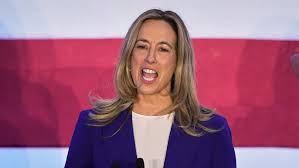

New Jersey has entered a defining political moment—one where federal pressure, state-level leadership, economic strategy, and core civil liberties are converging in real time. At the center of it all is Governor Mikie Sherrill, who delivered a forceful and unambiguous response to what she described as a politically motivated “fishing expedition” by the administration of Donald Trump into abortion coverage policies across the Garden State.
Her message was not calibrated or cautious—it was direct, urgent, and rooted in a broader ideological clash that is rapidly escalating between federal authority and state autonomy.
“Let me be perfectly clear: I will fight tooth and nail to defend and protect New Jerseyans’ abortion rights against attacks from Donald Trump, or anyone else,” Governor Sherrill declared, positioning New Jersey as a frontline state in the ongoing national debate over reproductive rights and federal overreach.
The administration’s inquiry—framed by Sherrill as a misuse of federal resources—targets how health insurance providers in New Jersey comply with laws that guarantee access to reproductive healthcare, including abortion services. Under current state policy, insurers are required to adhere to statutory protections that safeguard reproductive freedom, making New Jersey one of the most proactive states in preserving access in a post-Roe political environment.
For Sherrill, the issue extends far beyond policy interpretation. It is about intent.
She characterized the investigation as a distraction at a time when Americans are facing mounting economic pressure, rising costs, and broader uncertainty. “This is nothing but a fishing expedition wasting taxpayers’ money,” she said, tying the federal action to what she described as ineffective national leadership and misplaced priorities.
That critique lands in a moment when New Jersey itself is navigating a complex and high-stakes fiscal landscape—one that was brought into sharp focus during the first public hearing on the state’s proposed $60.7 billion Fiscal Year 2027 budget.
As detailed throughout ongoing coverage in the politics section, the state’s budget process is not just about numbers—it’s about direction, discipline, and defining what economic resilience looks like in an era of structural imbalance.
The Assembly Budget Committee, led by Eliana Pintor Marin, convened for more than six hours of testimony, signaling the seriousness of the decisions ahead. With a compressed timeline and a statutory deadline looming at the end of June, lawmakers, business leaders, and advocacy groups are now fully engaged in shaping what could become one of the most consequential budgets in recent state history.
At its core, the Sherrill administration’s plan attempts to strike a difficult balance: fully funding the state pension system, expanding investments in K–12 and early childhood education, and delivering property tax relief through programs like ANCHOR, Stay NJ, and Senior Freeze—all while addressing a structural deficit that has hovered around $3 billion.
The proposed budget also reflects a pivot toward fiscal discipline, with approximately $2 billion in spending reductions aimed at narrowing that gap. Yet even as those efforts have been acknowledged by the business community as a step in the right direction, significant concerns have emerged around proposed revenue measures that critics argue could undermine New Jersey’s economic competitiveness.
Industry voices, including those from the New Jersey State Chamber of Commerce and the New Jersey Business & Industry Association, have been particularly vocal about provisions such as caps on net operating loss deductions, changes to the alternative business calculation, and the introduction of an employer health assistance contribution.
These proposals, while projected to generate hundreds of millions in revenue, are viewed by some as adding pressure to an already challenging business environment—one shaped by high tax burdens, shifting workforce dynamics, and regional competition.
What makes this moment especially complex is how these economic debates intersect with the broader political tensions now playing out between New Jersey and Washington.
On one side, a federal administration pursuing an aggressive review of state-level reproductive health policies. On the other, a governor doubling down on both economic stabilization and the defense of individual rights.
The overlap is not coincidental—it reflects a larger national trend where policy, politics, and economics are no longer operating in separate lanes. Instead, they are deeply intertwined, influencing one another in ways that are reshaping how states govern and how residents experience those decisions in their daily lives.
For New Jersey, the stakes are amplified by its identity as both an economic engine and a policy leader. The state’s commitment to reproductive rights has been codified into law, its investments in education and infrastructure remain central to its long-term strategy, and its business climate continues to evolve amid calls for reform and restraint.
Governor Sherrill’s response to the federal investigation reinforces a broader narrative: that New Jersey is not retreating from these positions, even under scrutiny. Instead, it is asserting them more forcefully, framing the state as both a defender of rights and a steward of economic responsibility.
Meanwhile, the legislative process continues. Additional hearings are scheduled, public testimony is ongoing, and negotiations are expected to intensify as lawmakers work toward a final budget agreement before the June 30 deadline.
Each of these developments—federal investigation, gubernatorial response, budget negotiations, and business reaction—are not isolated events. They are components of a larger story unfolding across New Jersey, one that reflects the pressures and possibilities of governing in a deeply polarized and rapidly changing political landscape.
As the state moves forward, the outcome of these overlapping battles will shape not only policy, but perception—defining how New Jersey positions itself nationally on issues of rights, economics, and leadership in a year where every decision carries heightened consequence.