


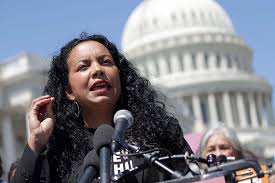

The race for New Jersey’s 11th Congressional District is accelerating, and the political alignment lines are becoming sharper. In a significant development that signals growing momentum among organized labor, Analilia Mejia, the Democratic nominee in the NJ-11 special election, has secured the endorsement of the Eastern Atlantic States Regional Council of Carpenters — one of the nation’s largest and most influential building trades unions.
The endorsement represents more than a symbolic nod. It signals institutional labor strength entering the race in a district that has historically been politically competitive and economically diverse. The special general election is set for April 16, 2026, and the stakes extend far beyond party control — this is a contest framed around working-class advocacy, fiscal priorities, and the broader ideological direction of New Jersey politics.
A Major Building Trades Endorsement in NJ-11
The Eastern Atlantic States Regional Council of Carpenters (EASRCC) represents more than 15,000 members across New Jersey and thousands more throughout the region. Its footprint spans commercial construction, infrastructure projects, and public works — sectors that directly intersect with federal policy on labor standards, infrastructure spending, and wage protections.
By endorsing Mejia, the union aligns itself with a candidate whose professional background is rooted in organized labor. Before entering the congressional arena, Mejia spent a decade as a union organizer with 32BJ SEIU, UNITE HERE, and UFCW. She has also been closely associated with advocacy efforts that led to New Jersey’s $15 minimum wage and paid sick leave expansions.
In accepting the endorsement, Mejia emphasized economic justice and wage protections, positioning herself as a continuation of labor-focused legislative priorities. The endorsement from EASRCC builds on an expanding coalition of union support that already includes 32BJ SEIU, 1199 SEIU, the SEIU New Jersey State Council, AFSCME, CWA District 1, CWA Local 1037, Rutgers AAUP-AFT, and the Rutgers Adjunct Faculty Union.
In modern New Jersey politics, labor endorsements carry structural weight. They mobilize ground operations, activate membership networks, and influence turnout in tightly contested districts.
Understanding NJ-11: Why This Seat Matters
New Jersey’s 11th Congressional District encompasses portions of Morris, Essex, and Passaic counties. It blends suburban commuter communities with working-class towns and small business corridors. The district reflects the broader tensions shaping New Jersey’s political landscape: high property taxes, infrastructure concerns, school funding debates, and public safety issues.
For labor organizations, NJ-11 represents a strategic opportunity to solidify pro-union representation at the federal level. For fiscal conservatives and government reform advocates, it represents a battleground over state and federal spending priorities.
Mejia’s campaign messaging has centered on raising wages, protecting worker rights, and building what she describes as an economy that works for all families. The carpenters’ endorsement strengthens her credibility in construction and infrastructure sectors that are heavily influenced by federal funding streams.
The Expanding Role of Organized Labor in New Jersey Elections
New Jersey has long been a labor-strong state, particularly in public sector unions and building trades. Endorsements from large unions often shape primary elections — but in a special general election, they can also influence swing voters who prioritize economic stability and job creation.
The Eastern Atlantic States Regional Council of Carpenters, under the leadership of Executive Secretary-Treasurer William Sproule, framed its endorsement as a reflection of Mejia’s alignment with middle-class job growth and economic justice.
Building trades unions traditionally focus on infrastructure investment, project labor agreements, apprenticeship programs, and prevailing wage enforcement. These priorities intersect directly with federal appropriations and congressional oversight.
With billions in federal infrastructure funding flowing through New Jersey, the composition of the state’s congressional delegation carries real economic consequences.
The Broader Political Climate: Protests and Policy Debates
Mejia’s endorsement announcement comes amid a politically charged environment in New Jersey.
Recent protests in Princeton drew crowds opposing military strikes, mirroring demonstrations in neighboring New York City. Meanwhile, over 1,500 residents and advocates are protesting a proposed ICE detention center in Roxbury that would convert a 470,000-square-foot warehouse into a facility for up to 1,500 detainees.
These developments underscore the heightened political engagement across suburban New Jersey communities. Immigration policy, federal enforcement, and civil liberties are front and center in public discourse.
In addition, fiscal spending priorities have become flashpoints in statewide debates. Critics have pointed to controversial expenditures including:
• Recreation center expansion projects featuring pickleball courts and Olympic-size pools
• Offshore wind investments that have drawn scrutiny over rising utility costs
• Funding allocations to politically connected districts
• Education funding formula disputes affecting Highlands communities
• Cultural investments such as the proposed Pompidou art museum
• Universal preschool expansion debates amid ongoing K-12 funding equity concerns
These issues shape the broader narrative voters will carry into the NJ-11 special election.
Labor endorsements, therefore, are not operating in isolation. They intersect with public debates over spending discipline, infrastructure investment, school funding fairness, and economic growth strategy.
Economic Justice Versus Fiscal Scrutiny
The contrast in NJ-11 is likely to revolve around two overarching themes:
• Expanding worker protections and public investment
• Demanding stricter fiscal oversight and prioritization
Mejia’s background as a union organizer positions her firmly within the pro-labor investment framework. Her campaign messaging emphasizes raising wages, strengthening collective bargaining protections, and safeguarding worker benefits.
Opponents and fiscal watchdogs are expected to counter with arguments centered on state spending discipline, energy policy scrutiny, and taxpayer accountability.
For voters in Morris and Essex counties — where property taxes remain a constant pressure point — economic messaging must resonate beyond party lines.
Why the Carpenters’ Endorsement Is Strategically Significant
Building trades unions carry particular weight in districts with substantial construction, infrastructure, and redevelopment activity.
New Jersey continues to experience:
• Transit-oriented development expansion
• Highway and bridge modernization projects
• School construction initiatives
• Mixed-use redevelopment in suburban downtowns
Federal representation influences how infrastructure funds are allocated and how labor standards are enforced on those projects.
The carpenters’ endorsement signals that major segments of the building trades see Mejia as aligned with their economic interests.
In close elections, turnout among union households can determine outcomes.
April 16, 2026: A High-Stakes Special Election
Special elections often produce unpredictable turnout patterns. With the general election scheduled for April 16, 2026, mobilization efforts will intensify in the coming weeks.
Union endorsements typically translate into door-knocking operations, phone banking, and coordinated messaging campaigns targeting member households.
For NJ-11 voters, the race represents a referendum not only on candidate ideology but also on the broader trajectory of New Jersey’s economic and political priorities.
Will voters prioritize expanded labor protections and federal investment alignment? Or will fiscal restraint and spending oversight dominate the conversation?
What This Means for New Jersey’s Political Landscape
The endorsement of Analilia Mejia by the Eastern Atlantic States Regional Council of Carpenters solidifies labor’s early positioning in NJ-11. It reinforces the role of organized labor as a central force in New Jersey congressional races.
At the same time, the broader climate — from ICE detention center protests in Roxbury to debates over offshore wind and school funding — ensures that this election will not occur in a vacuum.
It will unfold against a backdrop of economic anxiety, policy disputes, and deeply engaged suburban communities.
For NJ-11, April 16 is more than a date. It is a defining moment in how New Jersey’s suburban districts navigate labor priorities, fiscal debates, and federal representation in a politically charged era.
Sunset Daily News New Jersey will continue comprehensive coverage as the special election approaches, tracking endorsements, policy positions, and voter engagement shaping the future of the 11th Congressional District.