


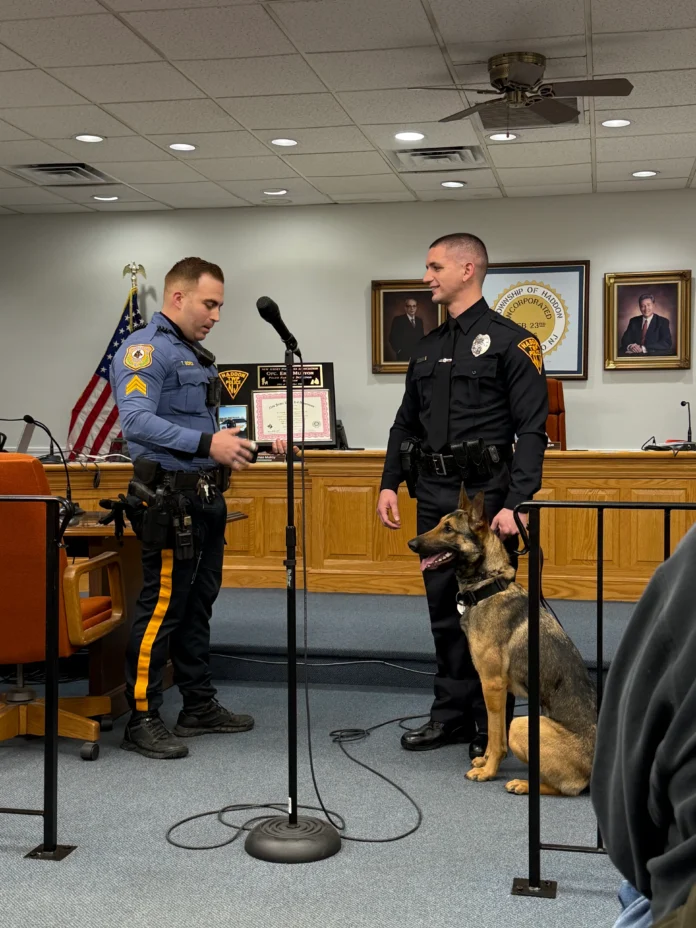

For the first time in three decades, Haddon Township has a police dog.
On Tuesday, K-9 Ivy was officially sworn into service, marking a significant milestone not just for the Camden County municipality, but for a growing regional movement across South Jersey. In recent years, neighboring Haddon Heights and Haddonfield have established their own K-9 units, while Pennsauken has implemented a crisis response Labrador — each department leveraging working dogs in distinct yet complementary ways.
This is not simply a story about tactical law enforcement. It is a story about evolving public safety strategy, community engagement, mental health response, and the misunderstood daily life of modern police K-9s.
Across New Jersey, K-9 units are increasingly viewed as both operational assets and outreach ambassadors — disciplined professionals on duty and trusted companions off the clock.
A 30-Year Gap Closed in Haddon Township
Haddon Township’s reintroduction of a K-9 unit represents more than symbolic progress. It reflects changing policing philosophies that emphasize visibility, community presence, and specialized capability.
For 30 years, the township operated without a police dog. During that period, law enforcement demands evolved dramatically. Today’s departments face not only traditional crime response but also crisis intervention, search-and-rescue operations, narcotics interdiction, and school outreach responsibilities.
K-9 Ivy’s swearing-in ceremony signals that Haddon Township is investing in proactive tools designed to enhance both enforcement precision and public trust.
Police K-9s bring capabilities that technology alone cannot replicate — scent tracking, suspect location, evidence recovery, and rapid area searches. But increasingly, departments are recognizing that these dogs also strengthen human connections within the community.
A Regional Trend: Haddon Heights, Haddonfield, and Pennsauken
Haddon Township is not alone in embracing the K-9 model.
Haddon Heights and Haddonfield founded their K-9 units only a few years ago, reflecting a broader South Jersey trend. Meanwhile, Pennsauken introduced a crisis response Labrador — a different type of K-9 deployment focused less on enforcement and more on mental health and trauma support.
This diversification illustrates how police dog programs are no longer one-dimensional.
Traditional patrol K-9s are typically trained for suspect apprehension, tracking, and narcotics detection. Crisis response or comfort dogs, by contrast, are integrated into schools, community events, and victim assistance programs. They provide emotional stabilization during traumatic incidents and serve as bridge-builders between officers and residents.
For departments navigating modern policing expectations, K-9 units offer both operational leverage and public-facing goodwill.
Debunking the “Cage” Myth: Where Police Dogs Really Live
One of the most persistent misconceptions about police dogs is that they live in cages at stations, confined except when deployed.
In reality, the vast majority of U.S. K-9s live with their handlers as members of the family.
These dogs typically go home every day after their shift. They interact with spouses, children, and other household pets. While departments often require a secure, specialized kennel — indoor or outdoor — on the handler’s property for liability and safety purposes, this does not mean perpetual confinement.
Most K-9s split time between structured kennel space and normal home environments. On off-days, they may lounge inside the house, play with family members, or engage in enrichment activities.
The “live-with-handler” model fosters deep bonding, which is critical for effective field performance. A K-9 and handler function as a unified team; trust and communication are non-negotiable.
Only in very large agencies do centralized 24/7 kennel facilities sometimes exist — and even then, dogs are regularly exercised, trained, and monitored. They are not left isolated indefinitely.
Work as Play: The Psychology of the Working Dog
Police K-9s are typically high-drive breeds such as Belgian Malinois or German Shepherds. These dogs are selected and trained for focus, stamina, and prey-drive intensity.
What may appear as rigorous “work” to observers — tracking suspects, locating narcotics, searching buildings — is, from the dog’s perspective, a highly rewarding game.
Training programs rely heavily on positive reinforcement and reward-based motivation. Detection and tracking are instinctual behaviors refined through repetition and structured play. For many K-9s, deployment is an opportunity to engage in their favorite activity.
Understanding this dynamic is essential when evaluating K-9 welfare. These animals are not reluctantly performing tasks; they are purpose-bred and purpose-trained to thrive in structured environments.
Health, Nutrition, and Retirement Realities
Active-duty K-9s receive specialized veterinary care, premium nutrition, and consistent conditioning. Many departments rely on municipal funding supplemented by community donations to ensure optimal health standards.
However, the physical and mental demands of the job are real.
Most police dogs retire between ages seven and ten. Years of high-impact activity can lead to arthritis, chronic injuries, or stress-related conditions.
Upon retirement, the overwhelming majority of K-9s are adopted by their handlers — often for a symbolic fee such as one dollar — allowing them to transition into full-time family life.
Yet retirement introduces a challenge that is less publicly discussed: medical expenses often shift entirely to the handler. While the dog may no longer be on payroll, veterinary needs can intensify with age.
In communities like Haddon Township and neighboring municipalities, public awareness and fundraising efforts frequently support retired K-9 care, reinforcing the reciprocal bond between law enforcement and residents.
Community Outreach: The Modern K-9 Advantage
Beyond tactical utility, K-9 units are among the most effective outreach tools available to local police departments.
School visits, National Night Out events, parades, and community festivals often feature police dogs as primary attractions. Children approach officers more readily when accompanied by a dog. Conversations that might otherwise feel formal or intimidating become accessible.
Crisis response dogs — such as Pennsauken’s Labrador — extend this benefit further. In situations involving domestic violence victims, child trauma, or disaster response, a trained comfort dog can lower cortisol levels, ease anxiety, and stabilize emotional distress.
For departments navigating the dual demands of enforcement and relationship-building, K-9 programs serve as strategic bridges.
Strategic Implications for Local Law Enforcement
The resurgence of K-9 units in Camden County municipalities reflects broader statewide trends.
Law enforcement agencies are increasingly balancing three priorities:
• Tactical capability enhancement
• Community trust restoration
• Mental health crisis responsiveness
K-9 programs intersect all three.
They provide operational advantages in suspect location and evidence detection. They humanize officers in public settings. And they expand nontraditional policing functions such as emotional support.
Haddon Township’s decision to reestablish a K-9 unit after 30 years underscores a calculated investment in multi-dimensional policing.
Looking Ahead for Haddon Township
With K-9 Ivy now officially sworn in, the township enters a new era of police operations and community engagement.
Residents can expect to see Ivy at patrol deployments, public demonstrations, school visits, and local events. The program’s success will hinge not only on enforcement metrics but also on the strength of its community integration.
As neighboring municipalities continue refining their own K-9 strategies, South Jersey is emerging as a case study in how smaller departments can modernize without sacrificing community identity.
The return of a police dog after three decades is not merely nostalgic — it is strategic.
And for Haddon Township, it marks the beginning of a new chapter where discipline, partnership, and public outreach walk side by side on four paws.