


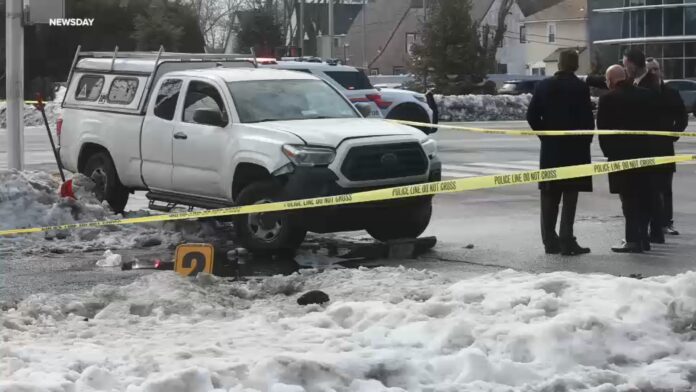

Newark, New Jersey—A federal enforcement operation spiraled into chaos this week when a high-speed vehicle pursuit involving U.S. Immigration and Customs Enforcement (ICE) ended in a violent multi-vehicle crash in Newark, leaving three children seriously injured and igniting fierce debate across New Jersey about public safety, federal authority, and accountability.
The early morning incident has quickly become one of the most consequential law enforcement controversies in the state this year, raising urgent legal and legislative questions that now extend well beyond the city limits of Newark.
High-Speed Pursuit Through Residential Streets
According to local officials, ICE agents attempted to stop a gray van as part of a federal operation. When the driver allegedly fled, a pursuit unfolded through residential corridors of Newark during morning traffic hours. The fleeing vehicle ultimately collided with multiple civilian cars, including a vehicle transporting two 15-year-old girls and a 12-year-old boy.
All three children were transported to University Hospital with serious injuries. The emotional toll on the families has been immediate and profound, with relatives describing shock and fear as news of the crash spread.
The van’s driver was taken into custody following the collision and reportedly sustained injuries as well. Federal officials have indicated that the individual was the subject of immigration enforcement action, though the broader operational details have not yet been publicly disclosed.
Mayor Ras Baraka Condemns the Operation
Newark Mayor Ras Baraka responded swiftly and forcefully, criticizing ICE’s decision to engage in a high-speed pursuit in a densely populated urban area. The mayor argued that such enforcement tactics place innocent civilians at unacceptable risk, particularly during school commute hours.
Baraka has maintained that vehicle pursuit protocols exist for a reason: to prevent precisely this type of collateral harm. Under New Jersey law enforcement guidelines, high-speed chases are typically limited to situations involving violent felonies or immediate public threats. The mayor questioned whether that threshold was met.
He also noted that road conditions and traffic patterns in urban neighborhoods make pursuits especially dangerous, amplifying the potential for unintended consequences.
Executive Action and Local Oversight Measures
In the aftermath of the crash, Mayor Baraka signed an executive order intended to limit ICE access to certain city properties without a judicial warrant and to empower city employees to observe federal operations occurring within Newark. The move reflects a broader municipal strategy to assert local oversight over federal enforcement actions when public safety concerns arise.
The executive action signals a potential escalation in the ongoing tension between federal immigration enforcement and local governance in New Jersey. It also aligns with Newark’s longstanding position on safeguarding immigrant communities while emphasizing community safety standards.
Structural Questions About Federal Enforcement in Urban Areas
The Newark ICE crash is not simply an isolated traffic accident. It underscores a deeper policy dilemma: how federal agencies conduct enforcement operations within densely populated municipalities that operate under distinct public safety frameworks.
Urban law enforcement agencies frequently restrict high-speed pursuits because of the elevated risk to bystanders. When federal agencies operate under separate protocols, jurisdictional friction can occur. This incident now forces renewed scrutiny of how those protocols intersect — or conflict — with state and municipal standards.
Public safety advocates argue that aggressive vehicular pursuits in residential neighborhoods create predictable risks, particularly when children and commuters are present. At the same time, federal authorities maintain that enforcement operations sometimes require decisive action to prevent suspects from evading arrest.
The question now confronting policymakers is how to reconcile those competing priorities without compromising civilian safety.
The Legislative Angle: Could Policy Changes Follow?
Given the intensity of public reaction, the Newark ICE incident may spark legislative discussion in Trenton. Lawmakers could examine whether clearer statutory boundaries are needed when federal agencies conduct enforcement within New Jersey municipalities.
Potential areas of focus may include:
• Formal interagency coordination requirements
• Clearer notification protocols for local law enforcement
• Expanded municipal oversight authority
• Stricter pursuit limitations within high-density areas
While no immediate legislative proposals have been formally introduced, political observers expect debate to intensify as additional facts emerge.
Public Safety, Community Trust, and Political Ramifications
Beyond legal implications, the crash has broader political significance. Community trust in law enforcement depends heavily on perceptions of proportionality and restraint. Incidents involving injured children amplify public concern and intensify scrutiny.
For Governor Mikie Sherrill’s administration and state lawmakers already navigating fiscal pressures and structural budget concerns, the Newark ICE incident introduces an additional layer of governance complexity. Public safety narratives can quickly evolve into broader conversations about state-federal relationships and executive authority.
As New Jersey’s political landscape continues to shift, this episode could become a defining moment in how the state negotiates federal enforcement presence within its borders.
What Happens Next
The injured children remain under medical care, and investigations into the precise sequence of events are ongoing. Both federal authorities and local officials are expected to review operational conduct, pursuit decisions, and compliance with applicable protocols.
Legal experts suggest that the incident may result in civil litigation, independent oversight review, or policy revisions depending on investigative findings.
For now, Newark residents are left grappling with a sobering reality: a federal enforcement action that began as a targeted stop ended with multiple vehicles destroyed and three children hospitalized.
The Newark ICE high-speed chase will likely remain a central issue in New Jersey political and legislative discourse in the weeks ahead. Sunset Daily News New Jersey will continue comprehensive coverage as official reports are released, executive actions evolve, and policymakers determine whether reforms are warranted.
In a state where public safety, governance, and federal authority intersect daily, this incident may prove to be more than a headline — it may become a turning point.



