


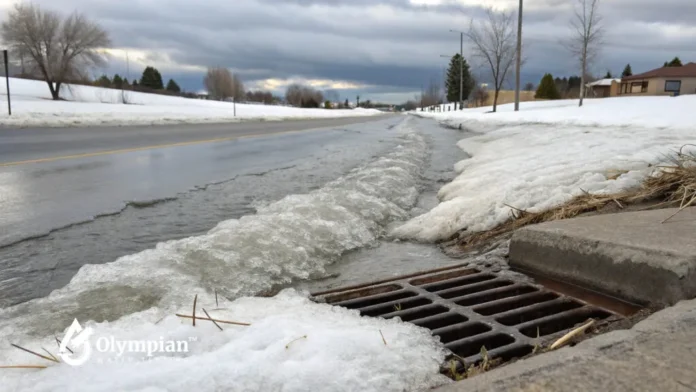

In New Jersey, winter does not end when the snow melts.
Long after the final plow clears the highways and sidewalks, the environmental consequences of road salt continue moving quietly through the state’s rivers, reservoirs, groundwater systems, and drinking water supplies. The issue is no longer seasonal — it is structural, cumulative, and increasingly urgent.
Each year, tens of thousands of tons of sodium chloride are applied to New Jersey roadways to keep drivers and pedestrians safe. The practice is effective. It reduces ice formation, lowers accident risk, and protects public safety during severe winter weather. But once that salt dissolves and runoff begins, the chemistry shifts. What protects motorists in January can remain embedded in waterways well into spring — and in some cases, far longer.
This is not speculation. Environmental monitoring across the region has shown that chloride levels spike dramatically during winter storms — and then remain elevated for months afterward. Unlike many pollutants, chloride does not biodegrade. It does not evaporate. It does not break down naturally. It persists.
Why Road Salt Stays in the System
When snow and ice melt, road salt travels in three primary directions:
• Into storm drains and surface waterways
• Into soil systems along roadways
• Into groundwater aquifers beneath developed areas
Once chloride enters groundwater, it can slowly discharge into streams over extended periods. That means even during dry weather in April or May, waterways can still show elevated salinity because of winter applications.
The hydrologic cycle does not reset with the calendar. The chemistry lingers.
Implications for Drinking Water in New Jersey
New Jersey relies heavily on a combination of reservoirs, rivers, and groundwater wells for public water supply. When chloride concentrations increase in source waters, treatment becomes more complex.
While current drinking water systems are generally operating within regulatory standards, elevated sodium levels can pose concerns for:
• Individuals on low-sodium diets
• Residents with hypertension or cardiovascular conditions
• Households relying on private wells
Unlike certain contaminants that can be filtered out through conventional treatment, dissolved chloride is difficult and expensive to remove. As concentrations increase over time, utilities may need to invest in blending strategies, infrastructure upgrades, or advanced treatment technologies — all of which can translate into higher operational costs.
The long-term trend is what matters most. Chloride accumulation is cumulative. Once it builds up in aquifers, reversing that trend is challenging.
Ecological Consequences in Freshwater Systems
Freshwater ecosystems are calibrated for stability. Even small shifts in salinity can alter biological balance.
Elevated chloride levels can affect:
• Macroinvertebrates such as mayflies and stoneflies
• Amphibians during breeding cycles
• Fish populations sensitive to chemical changes
• Aquatic vegetation critical to oxygen production
As biodiversity declines, entire aquatic food webs can destabilize. That affects recreational fishing, ecological resilience, and the overall health of watershed systems across the state.
In addition, increased salinity can alter soil structure along streambanks, reducing vegetation health and increasing erosion risks. Over time, this contributes to sedimentation issues that further degrade water quality.
Infrastructure and Long-Term Asset Impacts
The implications are not limited to ecology.
Salt accelerates corrosion in:
• Bridges
• Reinforced concrete
• Stormwater systems
• Underground utilities
As chloride infiltrates infrastructure systems, it reduces service life and increases maintenance costs. For municipalities already managing tight budgets, the long-term fiscal implications are significant.
This is where environmental impact intersects directly with construction, infrastructure resilience, and public works planning — a critical issue across New Jersey’s urban and suburban development corridors.
Can Road Salt Use Be Reduced?
Public safety remains non-negotiable. Roads must be treated during hazardous winter conditions. However, experts increasingly point toward smarter application methods rather than higher volumes.
Strategies gaining traction include:
• Pre-treatment with liquid brine to reduce total salt required
• Precision application technologies
• Updated municipal contracting standards based on calibrated spreading
• Increased training for public works departments
• Private property best-practices for commercial lots and residential driveways
Many property owners unknowingly apply far more salt than necessary. In most cases, a light, measured application is sufficient once surfaces are cleared of snow.
Small changes, multiplied across millions of driveways and commercial properties, can significantly reduce chloride runoff statewide.
A Growing Policy Conversation in New Jersey
State agencies and watershed groups are now evaluating long-term chloride trends more closely than ever before. The issue is moving beyond environmental advocacy and into infrastructure planning and regulatory discussions.
As development continues across northern and central New Jersey, stormwater systems are already under pressure. Adding persistent chloride accumulation to that equation complicates future planning.
New Jersey’s dense population, extensive roadway network, and proximity to sensitive water bodies — including tributaries feeding into major river systems — make this a uniquely regional challenge.
The Reality: This Is Not a One-Season Issue
The critical takeaway is simple:
Winter road salt does not disappear in March.
It remains in waterways for months. It migrates through groundwater. It accumulates year after year. And the long-term trajectory depends on how the state adapts its practices now.
Balancing roadway safety with environmental stewardship will require coordination between:
• State transportation departments
• Municipal public works
• Water utilities
• Construction planners
• Environmental regulators
• Private property owners
The solution is not elimination — it is optimization.
New Jersey’s winter safety strategy must evolve with data, technology, and forward-thinking infrastructure policy. As climate patterns shift and storm intensity fluctuates, adaptive management will become even more important.
For residents, the message is practical and immediate:
Use only what you need. Clear surfaces before salting. Consider alternative de-icing strategies where appropriate. Be aware that what goes on pavement today can end up in waterways tomorrow.
The snow may be gone, but the impact remains — moving quietly through the systems that sustain drinking water, wildlife, and infrastructure across the Garden State.
And this spring, as New Jersey transitions from thaw to bloom, the chemistry of winter will still be with us.