


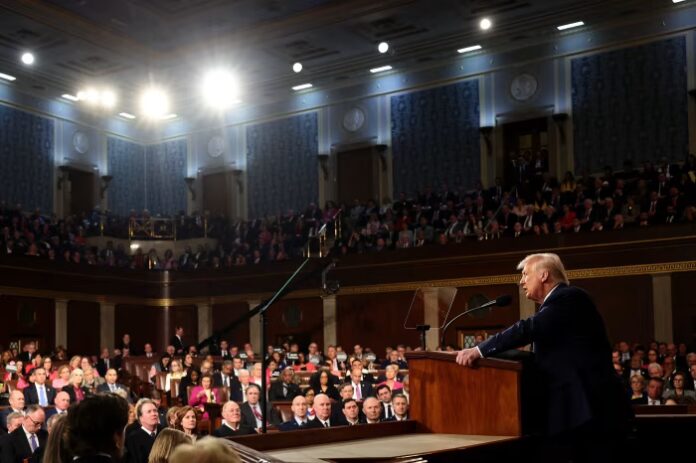

As President Donald Trump delivered his State of the Union address to Congress, political leaders across the country responded swiftly — and in South Jersey, Congressman Donald Norcross issued one of the strongest rebukes of the administration’s economic and immigration policies, arguing that “America First” has translated into higher costs, reduced protections, and deep uncertainty for working families in New Jersey’s First Congressional District.
Norcross’ statement framed the national address not as a declaration of strength, but as a moment of reckoning. While the President emphasized federal accomplishments under the “America First” banner, Norcross countered that families in Camden, Gloucester, and Burlington counties are feeling mounting financial pressure — from grocery bills and healthcare premiums to housing affordability and wage stagnation.
At the center of Norcross’ criticism is what he characterizes as a tariff-driven cost increase impacting consumers and small businesses alike. New Jersey’s economy is tightly interwoven with national and global supply chains. Manufacturing operations, port logistics networks, and small retail enterprises across the region depend on predictable trade flows. When tariffs increase input costs, Norcross argues, those increases are not absorbed quietly — they are passed down to families already managing tight household budgets.
The debate over tariffs is not abstract in New Jersey. The state’s proximity to the Port of Philadelphia and its interconnected warehousing infrastructure make it particularly sensitive to shifts in international trade policy. Norcross’ district includes working-class communities where many residents are employed in manufacturing, construction, transportation, and distribution. Rising material costs can ripple quickly through these sectors, influencing wages, overtime availability, and job security.
Healthcare and food assistance policy were also central to Norcross’ response. He pointed to what he described as sweeping cuts that threaten access to Medicaid and SNAP benefits for vulnerable residents. In a state where healthcare access remains a defining political issue — and where nonprofit hospital systems and community clinics serve as lifelines — any reduction in federal support carries measurable local consequences.
For many New Jersey families, federal healthcare policy determines whether prescription medications remain affordable, whether preventive care is accessible, and whether emergency visits lead to manageable bills or long-term financial hardship. Norcross’ statement underscored a broader Democratic concern that reductions in federal safety-net programs shift burdens to state governments and local communities already navigating budget constraints.
Immigration enforcement policy formed another pillar of his critique. Norcross accused federal immigration operations of instilling fear in communities rather than focusing narrowly on violent offenders. In South Jersey, where immigrant families contribute significantly to local economies and school systems, enforcement strategy carries tangible social and economic implications. Small businesses, agricultural operations, hospitality services, and construction firms often depend on immigrant labor. Policy uncertainty in this area can create workforce instability and community tension.
Norcross emphasized a distinction between targeted enforcement of violent crime and broad-based tactics that, in his view, undermine trust in public institutions. Transparency and accountability, he argued, are essential to maintaining both public safety and constitutional protections.
Politically, the exchange reflects a broader national divide over how “America First” policies should be measured. Supporters of the administration cite domestic manufacturing initiatives, border security priorities, and trade recalibration as necessary corrections to decades of globalization. Critics, including Norcross, argue that the costs have outweighed the benefits for working families.
For New Jersey voters, the issue is less about partisan rhetoric and more about day-to-day reality. Inflation pressures, housing affordability challenges, and healthcare costs remain front-of-mind in communities across the state. As 2026 approaches, economic confidence and perceived household stability are likely to shape political outcomes at both the federal and state levels.
Norcross closed his response by reiterating commitments to raising the federal minimum wage, protecting healthcare and food assistance access, and holding the administration accountable through congressional oversight. His message aligns with broader Democratic priorities in New Jersey, where affordability and economic security continue to dominate public discourse.
From an SEO and policy perspective, the implications are clear: the intersection of “America First” policies and New Jersey economic realities will remain a central political narrative. Terms such as “Trump tariffs New Jersey impact,” “State of the Union response NJ,” “Norcross healthcare cuts statement,” and “federal minimum wage New Jersey” are increasingly relevant in political search traffic.
As the national conversation unfolds following the State of the Union, one point is evident — New Jersey’s congressional delegation is positioning itself as a vocal counterweight to federal policy shifts it believes harm working families. Whether voters ultimately agree will depend on how economic indicators, healthcare access, immigration policy, and wage growth evolve in the months ahead.
For now, Norcross’ response ensures that the debate over the strength of the Union is not confined to the Capitol floor — it is being argued in the communities of South Jersey, where policy meets lived experience and where the consequences of national decisions are felt most directly.



