


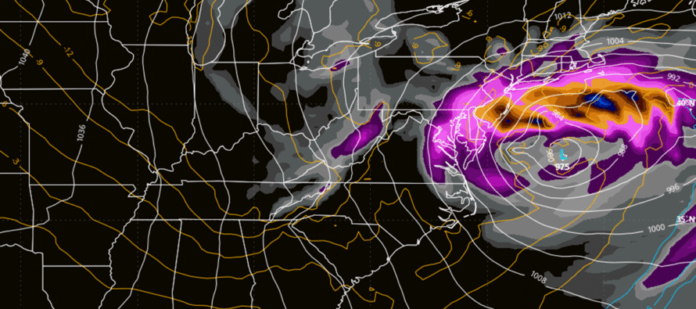

New Jersey residents and regional transportation officials are closely monitoring a developing winter weather system that could bring anything from a historic snowstorm to a relatively minor snowfall event across the state late Sunday through Monday. With early model guidance suggesting snow could begin as soon as 6–7 a.m. Sunday morning, the Garden State may be just over 60 hours away from the season’s most consequential winter weather decision point.
Despite the proximity of the potential storm, meteorological data remains divided, leaving forecasters in the final stages of critical “storm vs. no storm” analysis. The next 24 to 36 hours will determine whether New Jersey experiences a significant coastal winter event with widespread impacts or a lighter, shorter-duration snowfall affecting only portions of the region.
For transportation networks, infrastructure planning, and public safety readiness, the stakes are substantial.
Forecast Uncertainty Centers on Complex Upper-Level Atmospheric Dynamics
The uncertainty surrounding the potential Sunday–Monday snowstorm is rooted in highly complex upper-atmospheric interactions occurring thousands of miles away. Meteorologists are tracking multiple energy systems moving across North America that must align with precise timing for a major winter storm to develop along the East Coast.
Earlier in the week, attention focused on whether energy from Friday’s rain system would interfere with the developing storm. Initial concerns suggested lingering atmospheric energy could push the coastal system too far east into the Atlantic, sparing New Jersey from significant snowfall. However, updated model guidance now shows a separation of these systems, allowing the Sunday–Monday storm the opportunity to strengthen independently.
This shift eliminates one major obstacle to storm development, but the forecast remains highly sensitive to the interaction between two remaining atmospheric components:
• A polar wave of energy currently positioned over southwestern Canada
• A Pacific wave expected to move onshore over northern California
For a major snowstorm to occur, these two energy sources must merge—or “phase”—quickly enough to form a powerful closed upper-level low pressure system capable of intensifying a coastal storm near the East Coast.
If this phasing occurs efficiently, the developing coastal system could strengthen significantly and track closer to New Jersey, increasing snowfall totals, wind intensity, and coastal impacts.
If the interaction fails or occurs too late, the storm system would likely track out to sea, resulting in only lighter snow across parts of the state.
Competing Forecast Models Present Dramatically Different Outcomes
Major global weather models are currently presenting two distinct scenarios for New Jersey.
The American GFS model suggests an aggressive storm solution in which the polar and Pacific energy systems merge successfully, producing a powerful coastal low that strengthens near the Mid-Atlantic. This scenario would generate widespread snowfall across New Jersey, strong winds, and potential coastal flooding concerns.
Under this outcome, snowfall could begin early Sunday morning and continue through Monday night, producing prolonged winter weather impacts across transportation systems, roadways, and infrastructure.
Conversely, the European model presents a more restrained scenario. In this outcome, the polar wave fails to fully capture the Pacific energy, allowing the coastal storm to move out to sea. New Jersey would still experience snowfall, but impacts would likely be lighter and more localized, with the greatest accumulations northwest of the Interstate 95 corridor.
This scenario would bring:
• A shorter snowfall window
• Lower snowfall totals
• Reduced wind intensity
• Minimal coastal flooding risk
• Limited statewide disruptions
Most remaining forecast models fall somewhere between these two extremes, maintaining moderate snowfall potential but without consensus on intensity or geographic coverage.
Timing of Snowfall Remains Broad but Could Narrow Soon
While precise timing remains uncertain, forecasters agree that any impacts would occur between Sunday and Monday. The difference between scenarios could determine whether snowfall spans nearly two full days or occurs during a much shorter 6–12 hour window.
If the stronger storm scenario materializes, early projections indicate snowfall could begin as early as Sunday morning and taper off late Monday. A weaker system would produce a significantly narrower timeframe for accumulation and reduced overall impacts.
More precise timing will emerge after additional atmospheric data becomes available through upcoming model runs.
Final Decision Window Approaches for Snowfall Forecast
Meteorologists describe the current period as the final phase of storm determination. Atmospheric sampling and model updates through Friday’s major forecast cycles—including multiple model runs throughout the day—are expected to clarify storm development and allow forecasters to issue the first official snowfall projections.
These updates will determine:
• Expected snowfall intensity
• Geographic distribution of accumulation
• Wind and coastal impact potential
• Transportation disruption risk
• Overall storm classification
If strong model support persists, official snowfall maps and impact forecasts will be issued following the next full suite of model guidance.
At present, forecasters estimate roughly a 50/50 probability between a major snowstorm scenario and a more modest snowfall event.
Transportation Systems Prepare for Potential Impacts
New Jersey’s transportation infrastructure—including highways, airports, rail services, and coastal routes—could face significant operational challenges depending on storm development.
A stronger storm scenario would likely require widespread preparation measures, including road treatment operations, potential travel advisories, flight disruptions, and public transit adjustments. High winds and coastal flooding risks could further complicate operations in shore communities and low-lying areas.
A weaker storm would still require localized winter weather response but with more limited disruption across statewide travel networks.
The state’s transportation readiness remains closely tied to forecast updates, underscoring the importance of the next round of atmospheric data.
Additional coverage of regional infrastructure, mobility updates, and weather-related transportation developments can be found within Sunset Daily’s transportation coverage.
Potential Coastal and Infrastructure Risks
Should the more aggressive storm scenario materialize, forecasters warn that impacts would extend beyond snowfall totals. A deepening coastal low pressure system could generate:
• Strong coastal winds
• Beach erosion and coastal flooding
• Reduced visibility conditions
• Power outage risks
• Hazardous marine conditions
These risks would be substantially lower under the weaker storm scenario, which would primarily bring light to moderate snowfall without significant coastal threats.
What New Jersey Residents Should Expect Next
The next 24 hours represent the most critical forecasting period for determining the storm’s trajectory and potential severity. Meteorologists will evaluate how rapidly the Pacific and polar energy systems interact as they move across the central United States, a process that will ultimately dictate whether the storm strengthens near the East Coast.
Forecast confidence is expected to increase significantly following the latest round of model updates, which will provide clearer insight into storm structure, timing, and impact potential.
For now, New Jersey remains in a holding pattern—watching atmospheric conditions evolve while preparing for a range of winter weather possibilities that could define the state’s late-season forecast.
Whether the Garden State experiences a historic winter event or only scattered snow showers, the developing Sunday–Monday system highlights the dynamic nature of winter forecasting and the complex science driving modern weather prediction across the Northeast.