


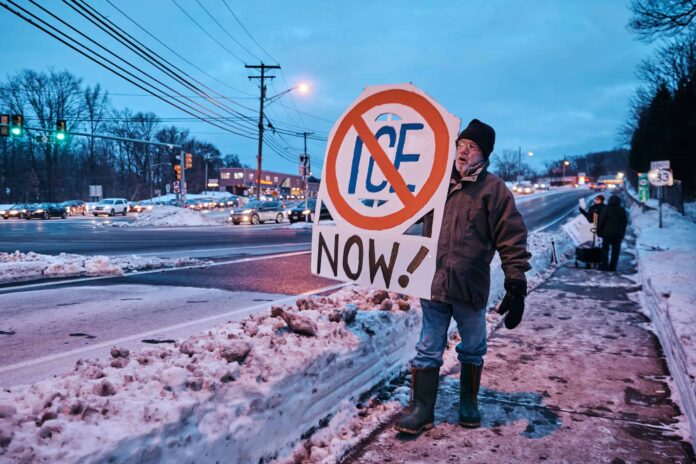

A reported federal acquisition of a warehouse along Route 46 in Roxbury Township has ignited one of New Jersey’s most charged political and policy debates of 2026 — drawing scrutiny from local officials, mobilizing grassroots activism, intensifying congressional pressure, and placing Representative Tom Kean Jr. at the center of a rapidly expanding public conversation.
At issue is whether a suburban Morris County industrial facility could soon house detainees under the authority of U.S. Immigration and Customs Enforcement (ICE). While confirmation remains elusive, the possibility alone has already reshaped the political landscape across the state, triggering immediate responses from federal lawmakers, energizing local Democratic leadership, and raising significant legal and administrative questions about federal authority, municipal oversight, and community impact.
The development represents more than a property transaction. It reflects broader tensions surrounding immigration enforcement, federal expansion into local jurisdictions, and the evolving policy direction of New Jersey’s leadership at a time when state and federal priorities increasingly collide.
The situation continues to unfold — but its implications are already reverberating statewide.
A Warehouse Purchase That May — or May Not — Have Happened
The controversy began when a report suggested that the federal government had purchased a warehouse property on Route 46 in Roxbury Township, a move widely interpreted as a precursor to establishing an ICE detention facility in Morris County.
Yet confirmation remains uncertain.
Local officials say they have not received formal notice from the Department of Homeland Security confirming such a purchase. Township attorney Anthony M. Bucco emphasized two key points: federal authorities have not verified the acquisition, and Dalfen Industrial — the company identified as the warehouse owner — maintains that no sale has occurred.
This ambiguity has created an unusual dynamic. On one side is a credible report suggesting imminent federal action; on the other, official denials and an absence of formal documentation.
The possibilities remain open:
• The acquisition could be pending finalization
• Disclosure may be delayed until regulatory steps conclude
• The report could prove inaccurate
Regardless of the outcome, the political reaction has been swift and decisive — demonstrating how even the prospect of expanded immigration enforcement infrastructure can trigger immediate statewide response.
Statewide Political Reaction Emerges Quickly
New Jersey’s Democratic leadership moved rapidly to condemn the possibility of a new ICE facility.
U.S. Senator Cory Booker issued a statement opposing the development, warning of the social and humanitarian implications associated with expanded detention operations. Senator Andy Kim joined the criticism, alongside the state’s Democratic House delegation.
Leading the congressional response was Representative Bob Menendez, who framed the issue in stark terms, arguing that ICE expansion in local communities has historically produced severe consequences and heightened tensions.
The response reflects a broader political alignment among New Jersey Democrats, many of whom have consistently opposed expanded federal immigration enforcement infrastructure within the state.
The reaction also highlights how immigration policy remains a defining political issue across New Jersey’s federal delegation — particularly in districts with large immigrant populations.
Yet amid the chorus of opposition, one voice remains notably absent.
The Spotlight Turns to Tom Kean Jr.
Representative Tom Kean Jr., whose congressional district includes Roxbury Township, has not publicly responded to the reported warehouse purchase. Requests for comment have not been returned, according to reports.
His silence has become a focal point of political discussion.
Morris County Democratic leaders issued a statement criticizing what they described as inaction, arguing that the absence of public opposition suggests tacit approval of federal expansion efforts. The county committee also highlighted recent protests in Roxbury, where hundreds of residents gathered to demonstrate against the potential facility.
The criticism places Kean in a politically sensitive position.
As a Republican representing a district that includes suburban communities with diverse political views, Kean faces competing pressures:
• Federal immigration enforcement priorities
• Local constituent concerns
• Statewide political dynamics
• Party alignment considerations
How he ultimately responds could shape not only the trajectory of the Roxbury debate but also future electoral dynamics in Morris County and beyond.
Local Resistance and Community Mobilization
At the municipal level, opposition has been immediate.
Township officials have expressed resistance to the idea of an ICE detention facility operating within Roxbury’s borders. Residents and activists have organized demonstrations, citing concerns ranging from civil liberties to community safety and local economic impact.
The scale of community mobilization reflects a broader pattern seen in other regions where proposed ICE facilities have drawn intense local opposition.
Critics raise several concerns:
• The humanitarian treatment of detainees
• The social impact on surrounding communities
• Potential strain on local infrastructure
• Transparency in federal decision-making
• The role of municipalities in federal enforcement operations
Supporters of federal enforcement efforts, however, argue that such facilities represent necessary components of national immigration policy and public safety strategy.
This clash of perspectives underscores the larger national debate now playing out within a single New Jersey township.
Pressure on State Legislators
Local Democrats have also called on state legislators representing New Jersey’s 24th legislative district — Assembly members Dawn Fantasia and Mike Inganamort and State Senator Parker Space — to publicly oppose the proposed facility.
Their involvement could prove significant.
State lawmakers possess influence over regulatory oversight, zoning considerations, and state-level policy responses. Their positions may help determine how aggressively New Jersey challenges federal actions within its borders.
The pressure campaign demonstrates how the Roxbury issue has rapidly expanded beyond municipal governance into a multi-level political confrontation involving local, state, and federal actors.
The Broader Policy Context in New Jersey
The Roxbury controversy emerges at a moment of substantial policy activity in New Jersey, particularly under Governor Mikie Sherrill’s administration, which assumed office in January 2026.
While the current dispute centers on immigration enforcement, the broader policy environment reflects a state government increasingly focused on economic stability, social services, and cost-of-living relief.
Governor Sherrill recently declared a State of Emergency on Utility Costs, launching several initiatives aimed at assisting residents facing rising energy expenses. Among them:
• A WIC Utility Relief Pilot providing one-time grants to eligible families
• Residential Universal Bill Credits to offset electricity costs
• A freeze on utility rate increases
These measures illustrate a governance approach emphasizing economic relief and social support programs — priorities that shape the broader political climate in which the Roxbury debate unfolds.
The contrast between federal enforcement expansion and state-level social assistance policies highlights an ongoing tension between Washington and Trenton over policy direction and community impact.
Legal and Administrative Questions Remain
Beyond political controversy, the situation raises significant legal and administrative questions.
If a federal detention facility is established in Roxbury, key issues could include:
• Federal preemption authority over local zoning regulations
• State and municipal oversight rights
• Contracting arrangements with private property owners
• Environmental and land-use compliance
• Public transparency requirements
Historically, disputes over federal detention facilities have produced complex legal battles involving jurisdictional authority and community rights.
Whether Roxbury becomes the site of such litigation depends largely on whether the reported purchase ultimately proves accurate.
A Defining Test for Federal–Local Relations
The Roxbury warehouse debate represents a defining moment in New Jersey’s evolving relationship with federal immigration policy.
It tests several core questions:
• How much influence should local communities have over federal enforcement infrastructure?
• What role should state governments play in resisting or accommodating federal actions?
• How should elected officials balance national policy objectives with constituent concerns?
The answers could shape future federal activity across New Jersey and potentially influence policy responses in other states facing similar situations.
What Happens Next
For now, uncertainty remains the dominant feature of the Roxbury story.
Key developments to watch include:
• Confirmation or denial of the federal property purchase
• Public statements from Representative Tom Kean Jr.
• Additional community demonstrations or local government action
• Potential state legislative involvement
• Federal agency clarification
Even if the warehouse ultimately never becomes an ICE facility, the episode has already demonstrated the speed at which local developments can escalate into statewide political flashpoints.
A Community at the Center of a National Debate
Roxbury Township now sits at the intersection of national immigration policy, state political priorities, and local community identity. The unresolved status of the Route 46 warehouse has turned a suburban industrial property into a symbol of larger policy tensions shaping New Jersey and the nation.
Whether the facility materializes or not, the controversy has already reshaped political alliances, activated grassroots organizing, and intensified scrutiny of elected officials at every level of government.
As the situation develops, one thing remains clear: in Roxbury, all eyes are not only on ICE — they are also on the leaders who will define New Jersey’s response.



