



New Jersey is entering a potentially volatile stretch of winter weather as forecasters closely monitor a developing storm system that could bring significant snowfall, coastal impacts, and widespread travel disruptions across the state late this weekend. With overcast skies, damp conditions, and lingering fog already affecting all 21 counties, the evolving atmospheric setup has captured the attention of meteorologists and emergency planners alike.
As of Wednesday, February 18, New Jersey is experiencing mist, light rain, and seasonably cool temperatures, but the focus has rapidly shifted toward a potential Nor’easter that could intensify late Sunday into Monday morning. While uncertainty remains, emerging weather models suggest the possibility of anything from scattered precipitation to a high-impact winter storm event.
The coming days will play a critical role in determining the outcome, but early indicators show a strengthening storm signal that could shape travel, infrastructure readiness, and regional safety planning across the Garden State.
Current Conditions: Damp Weather and Widespread Fog Set the Stage
New Jersey’s immediate weather pattern reflects a transitional setup ahead of the potential weekend storm system. Overcast skies, persistent moisture, and fluctuating temperatures have dominated conditions statewide.
High temperatures Wednesday are reaching the mid-40s, with overnight lows expected to fall into the mid-30s. Earlier in the day, a Dense Fog Advisory was issued across all counties, with reduced visibility affecting major roadways and coastal areas. Patchy fog may continue through the evening, creating hazardous driving conditions.
This damp and relatively mild pattern is part of a broader atmospheric transition that meteorologists say is helping to establish the ingredients for a possible winter storm later in the week.
Short-Term Forecast: Rain, Wintry Mix, and a Brief Calm Before the Storm
The immediate forecast shows a progression of unsettled weather conditions leading into the weekend.
Thursday will remain cloudy with temperatures near 41 degrees. Light rain or drizzle is expected during the afternoon, with the possibility of freezing rain or a wintry mix developing overnight in northern counties, particularly in higher elevations.
Friday is projected to bring steady and potentially heavy rainfall across most of the state, with temperatures holding in the low-to-mid 40s. This widespread precipitation may saturate soils and create localized flooding concerns in low-lying areas.
Saturday offers a temporary break in the active pattern, with partly sunny skies and milder temperatures rising into the upper 40s and low 50s. However, this brief window of calmer weather may serve only as a precursor to a rapidly developing coastal storm system.
Weekend Storm Watch: Nor’easter Potential Emerges
Forecasters are closely tracking a developing system that could begin impacting the region Sunday afternoon and continue through Monday morning. The storm’s trajectory and intensity remain uncertain, but early projections indicate the potential for significant precipitation and strong winds.
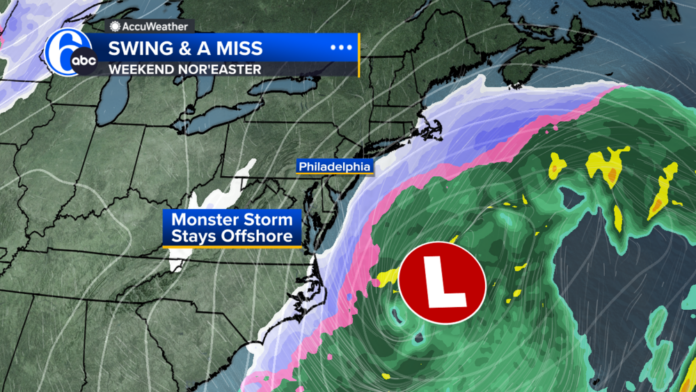
Current modeling suggests a wide range of outcomes. Some scenarios show a powerful winter storm capable of producing heavy snowfall and coastal impacts, while other projections indicate the system could track farther offshore and largely miss New Jersey.
At present, North Jersey carries roughly a 20 percent probability of receiving six inches or more of snow. While this probability remains modest, the strengthening storm signal has prompted increased monitoring.
Atmospheric Drivers: Why the Storm Signal Is Building
The potential storm is being driven by complex atmospheric interactions identified through teleconnection analysis — large-scale climate patterns that influence weather behavior across continents.
Meteorologists have identified a transition in the North Atlantic Oscillation (NAO), shifting from negative to positive phases, combined with fluctuations in the Pacific-North American pattern (PNA) and the Eastern Pacific Oscillation (EPO). This configuration traditionally supports the development of a temporary ridge over the western United States and a storm trough over the eastern United States.
This setup creates favorable conditions for coastal storm development, particularly during February, when ocean temperatures are at their coldest and atmospheric energy gradients are strongest.
The current pattern also includes a temporary blocking feature in eastern Canada that could slow storm movement and enhance intensification if timing aligns correctly.
Upper-Level Dynamics: The Key to Storm Formation
Upper-level atmospheric conditions play a decisive role in determining whether New Jersey experiences a major snowstorm or minimal impact.
Current modeling shows a ridge forming in the western United States with a storm trough developing over the eastern region. A blocking pattern near 50°N/50°W, combined with a ridge in eastern Canada, could steer the storm system toward the Mid-Atlantic coastline.
This temporary block may slow the storm’s progression, allowing it to strengthen as it interacts with cold air masses over the region. However, the block is not expected to persist for an extended period, meaning timing will be critical.
If the system phases correctly with the upper-level trough, rapid intensification could occur. If not, the storm may remain weak or move offshore with limited impact.
Surface-Level Development: Two Possible Scenarios
The behavior of the surface low pressure system will ultimately determine the storm’s impact.
One scenario suggests the storm could originate in the southeastern United States, track along the Outer Banks, and curve toward the Mid-Atlantic coast. If the upper-level trough pulls the system closer to shore, a powerful winter storm could develop with heavy snowfall and strong winds.
Alternative projections show the storm forming later and tracking farther offshore, resulting in only scattered rain or snow showers rather than a significant event.
Current modeling differences illustrate the uncertainty. Some simulations show a stronger low pressure system near 986 millibars tracking closer to the coast, while others indicate a weaker system around 996 millibars remaining offshore.
Forecast Uncertainty Remains High
Despite growing support from multiple forecasting models, meteorologists emphasize that the system remains five days away — a timeframe that allows for significant changes in storm track, intensity, and precipitation type.
Forecast confidence is expected to improve by Thursday, with more definitive storm track projections likely by Friday. Until then, forecasters anticipate continued variability across model solutions.
The range of possibilities remains wide, from minimal precipitation to a major winter storm affecting large portions of the Mid-Atlantic and Northeast.
Timeline of Potential Impacts
The evolving forecast currently suggests the following progression:
Milder temperatures and scattered rain through midweek will continue melting remaining snow cover across the state. Additional rainfall is expected Friday, with a possible wintry mix in northern elevations.
Saturday provides a brief period of calmer weather before temperatures drop early Sunday.
Precipitation may begin Sunday afternoon and continue into Monday morning, potentially bringing moderate to significant winter weather depending on storm development.
Coastal and Infrastructure Concerns
If the storm intensifies near the coastline, strong winds and coastal impacts could accompany snowfall, particularly along the Jersey Shore. Unlike lighter winter events, this system has the potential to produce powerful wind conditions if full development occurs.
Transportation networks, utility providers, and emergency management agencies are monitoring the situation closely, particularly given the potential for rapid changes in storm intensity.
Preparedness Guidance for Residents
With the storm signal strengthening, residents are encouraged to begin preliminary preparedness planning. Officials recommend monitoring weather updates, reviewing emergency supplies, and preparing for possible travel disruptions.
Basic readiness measures may include stocking essential groceries, checking emergency equipment such as flashlights and batteries, and ensuring vehicles and generators are properly fueled.
Early preparation allows households to respond quickly if forecasts indicate increased risk later in the week.
A Critical Weather Watch for New Jersey
New Jersey now enters a period of heightened weather monitoring as meteorologists track one of the season’s most significant potential storm signals. While uncertainty remains high, the atmospheric setup shows increasing support for a developing coastal system that could impact the region.
Over the next several days, updated modeling will determine whether the Garden State experiences a routine winter system or a high-impact Nor’easter with widespread effects.
For now, forecasters stress vigilance, preparedness, and continued monitoring as New Jersey approaches a weekend that could bring one of the most consequential winter weather events of the season.