


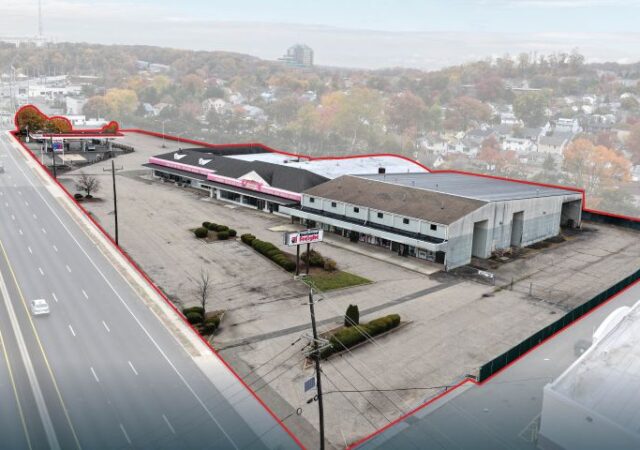

A long-vacant retail property in Clifton is set for a major transformation after new acquisition financing cleared the way for a comprehensive redevelopment and tenant repositioning along one of North Jersey’s most heavily traveled commercial corridors.
JLL Capital Markets announced it has arranged a three-year, floating-rate $11.5 million loan to support the acquisition and redevelopment of a retail center located at 1030–1050 Route 46, near the high-volume intersection of Route 46 and Route 3. The financing was placed through Fidelity Investments on behalf of an undisclosed buyer.
The property, which spans approximately 4.3 acres, is now positioned to be reintroduced to the Clifton market as a modern, grocery-anchored community retail destination. The new owner is planning roughly $1.5 million in capital improvements designed to reposition the center and support a diversified, service-oriented tenant mix aimed at everyday neighborhood demand.
JLL said the center was already approximately 80 percent pre-leased at the time of closing, signaling strong early leasing traction and retailer confidence in the location’s long-term performance.
The redevelopment effort focuses on transitioning the formerly underutilized site into a high-functioning convenience and community hub. According to project details, the proposed improvements are intended to support new uses that will bring daily traffic back to the property and strengthen its role within the surrounding residential and commuter base.
Public records show that the Clifton Zoning Board of Adjustment recently reviewed site plan approvals and use variances tied to the project. The proposals, attributed to Albi Properties LLC, include the addition of a supermarket and a day care center within the existing shopping center footprint. The plans also call for a new indoor playground concept paired with a restaurant and food court, which would further expand the property’s family-oriented and experiential offerings.
If fully implemented, the updated tenant mix would reflect the broader shift in retail real estate toward essential services, food, health, and experience-driven uses that are less vulnerable to e-commerce competition.
Planned upgrades at the site will include exterior façade enhancements, new signage and branding elements, parking lot repairs and resurfacing, HVAC system replacements, roof improvements and other building modernizations intended to elevate the overall customer experience and support long-term operational efficiency for incoming tenants.
Construction is expected to begin immediately following the closing, with full stabilization projected within approximately 18 months.
JLL’s Capital Markets Debt Advisory team, led by Director Ryan Carroll alongside Nazario Paragano and analyst Christian Badalamenti, structured the transaction and worked with the borrower to secure financing for the repositioning strategy.
Carroll said the transaction reflects continued investor confidence in well-located retail assets that offer clear redevelopment and re-tenanting potential, particularly in established suburban markets such as Clifton. He noted that the site’s location, combined with the ownership group’s operating history, played a significant role in attracting lender interest for the project.
The center’s location remains one of its strongest competitive advantages. Situated along Route 46 and immediately adjacent to Route 3, the property sits within a corridor that carries an estimated 56,000 vehicles per day, making it one of the most visible retail sites in the region.
Market fundamentals across North Jersey continue to support investor and lender interest in grocery-anchored and service-based retail properties. Industry data shows that vacancy rates throughout much of the region remain historically low, while rent growth has stayed relatively stable despite broader economic uncertainty.
In the Route 3 and Garden State Parkway submarket, vacancy has hovered near 1.7 percent for several consecutive years, underscoring the limited supply of well-located retail space and the difficulty of delivering new construction in already developed corridors.
Retail investment professionals note that rising construction costs, land constraints and more selective lending conditions have significantly slowed new retail development across the state. As a result, existing centers that can be repositioned and modernized are increasingly viewed as some of the most attractive opportunities for investors seeking stable, long-term cash flow.
The Clifton project also aligns with broader national retail trends, where grocery, personal services, childcare, dining and family entertainment uses are driving absorption in suburban markets. Industry outlooks for 2026 continue to point to a tightening supply environment for well-performing neighborhood and community centers, particularly those anchored by food and necessity-based tenants.
With limited new retail inventory entering the market, repositioned assets that can capture unmet local demand are expected to remain highly competitive among both tenants and lenders.
As redevelopment efforts move forward, the Clifton center is expected to become a prominent example of how aging retail properties can be successfully repositioned to meet modern consumer behavior while strengthening the surrounding commercial landscape.
Readers following major commercial property transactions and redevelopment activity across the state can find expanded coverage in Sunset Daily News’ New Jersey real estate section.



