


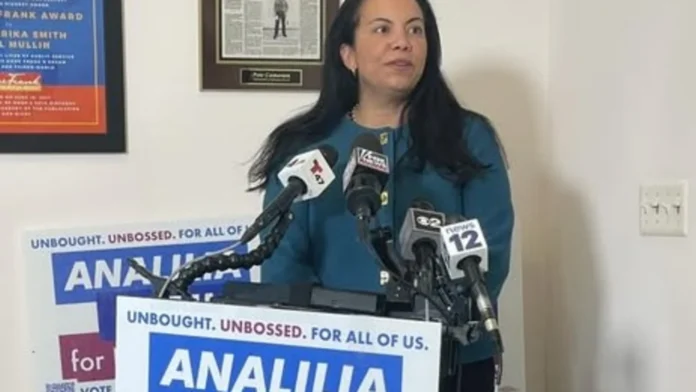

A dramatic shift in New Jersey’s political landscape unfolded Tuesday night as progressive organizer Analilia Mejia defeated former congressman Tom Malinowski in the Democratic primary for the state’s 11th Congressional District, marking one of the most closely watched special elections in North Jersey in recent years.
With nearly all ballots counted by the evening of February 10, Mejia held a lead of just under 900 votes, prompting Malinowski to formally concede before the race was officially certified. The outcome delivers a major victory for the progressive wing of the Democratic Party and signals a notable change in direction for a district that has traditionally balanced pragmatic, center-left politics with more moderate representation.
Mejia’s campaign, fueled by a highly energized grassroots operation and a wave of national progressive support, gained critical momentum in the closing weeks of the race. She received a high-profile endorsement from U.S. Senator Bernie Sanders, a move that amplified national attention on what had been a low-profile special election but quickly evolved into a symbolic test of ideological strength inside the Democratic Party.
The 11th District seat became vacant after Mikie Sherrill resigned from Congress following her successful election as governor, triggering a fast-moving primary contest that drew intense interest from party leaders, labor groups and advocacy organizations across the state.
Malinowski, who previously represented the district in Congress, entered the race with significant name recognition and an established political network. However, the contest increasingly centered on contrasting visions for the party’s future, particularly around immigration policy, economic justice and law enforcement accountability.
Mejia built her campaign around a message of systemic reform, expanded protections for immigrant communities, and a call for stronger alignment between Democratic leadership and grassroots activists. Her supporters mobilized heavily in high-turnout precincts throughout the district, particularly among younger voters and first-time participants drawn by her progressive platform.
By Tuesday night, with vote tallies continuing to narrow the path to a comeback, Malinowski acknowledged defeat, clearing the way for Mejia to move directly into a general election campaign that will now draw statewide attention.
Mejia will face Republican nominee Joe Hathaway in the April special general election to fill the remainder of Sherrill’s term. The race is expected to become an early test of voter enthusiasm in a district that has been central to recent statewide and national election strategies.
Political analysts note that the outcome reflects broader shifts within New Jersey’s Democratic electorate, particularly in suburban and urban districts where progressive organizing networks have grown rapidly over the past two election cycles. The result also highlights how local contests are increasingly shaped by national political narratives and ideological movements.
The narrow margin of victory underscores how deeply divided Democratic voters were over the future direction of the party in the district. While Malinowski maintained strong support among more traditional Democratic constituencies and long-time party activists, Mejia’s campaign successfully converted national progressive momentum into local turnout.
The special election now places New Jersey’s 11th District at the center of the state’s evolving political conversation, especially as lawmakers and party leaders prepare for a broader and highly competitive election cycle. Observers say the race is already influencing internal Democratic strategy discussions around messaging, voter engagement and policy priorities.
The April general election will determine whether Democrats can retain control of the seat and whether Mejia’s progressive coalition can expand its reach beyond the primary electorate. Republican leaders have indicated that they view the special election as an opportunity to test new campaign approaches in a district that, while leaning Democratic in recent years, remains politically diverse and highly sensitive to economic and public safety issues.
State political leaders and advocacy groups are also watching closely to see how Mejia positions herself during the transition from primary challenger to general election nominee. Her ability to unify a party that emerged from a competitive and ideologically charged primary will be critical in the weeks ahead.
For ongoing coverage of New Jersey elections, campaigns and legislative developments shaping the state’s political landscape, readers can follow Sunset Daily’s dedicated politics coverage through our embedded New Jersey politics reporting.
As the countdown to April begins, the 11th District contest is now poised to become one of the most closely monitored special elections in the region, offering early insight into how progressive energy, voter turnout and party alignment may shape New Jersey’s political future in the year ahead.



