


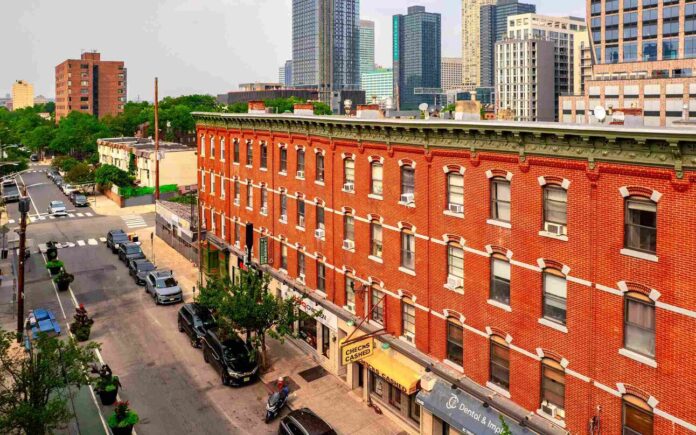

A prominent mixed-use property in the heart of Downtown Jersey City’s Powerhouse Arts District has closed for $6.25 million, underscoring continued investor confidence in one of New Jersey’s most competitive urban real estate markets.
The four-story brick building at 358–362 Grove Street spans approximately 16,050 square feet and features a diversified layout that includes 19 residential apartments and three street-level retail spaces. The transaction reflects sustained demand for well-located, income-producing properties in transit-oriented neighborhoods that continue to draw both residents and commercial tenants.
Situated just steps from the Grove Street PATH station, the property offers direct access to Manhattan and remains strategically positioned within Jersey City’s core commercial and cultural corridor. The building’s proximity to restaurants, arts venues, nightlife and office centers makes it especially attractive to renters seeking walkable, commuter-friendly housing options, while retailers benefit from consistent pedestrian traffic throughout the day and evening.
The sale was brokered by Marcus & Millichap, whose New Jersey investment sales team represented the seller and procured the buyer. The brokerage team was led by Devin Perez, Alan Cafiero and Dean Matuszewicz, all of whom specialize in urban mixed-use and multifamily transactions across the region.
According to market participants involved in the transaction, the property generated multiple competitive offers, highlighting the depth of capital actively pursuing stabilized assets in Jersey City’s downtown core. Despite higher interest rates and cautious underwriting across the broader commercial real estate landscape, investor appetite remains especially strong for assets that combine residential density with street-level retail in highly visible, transit-served locations.
Built in 1900, the Grove Street building retains much of its original architectural character while functioning as a modern income-producing property. The combination of historic construction, durable brick exterior and flexible mixed-use layout continues to resonate with buyers seeking long-term value and resilience in high-demand submarkets.
The retail portion of the property is currently occupied by popular neighborhood tenants, including Jibeichuan Ramen and Chicken & Co., both of which draw consistent foot traffic from commuters and nearby residential developments. Being positioned directly along one of Downtown Jersey City’s most active commercial blocks allows retailers to capture daily patronage from residents, office workers and visitors moving through the district.
From an investment perspective, properties such as 358–362 Grove Street represent a particularly attractive segment of the market. Mixed-use assets provide diversified income streams and tend to outperform single-use buildings during periods of market uncertainty, especially when residential occupancy remains strong and retail tenancy is supported by a dense, growing population base.
Downtown Jersey City continues to benefit from sustained population growth, new residential development and a steady influx of professionals drawn by its proximity to New York City and expanding local employment opportunities. The Powerhouse Arts District, in particular, has evolved into one of the city’s most sought-after neighborhoods, blending residential towers, converted industrial buildings, creative spaces and destination dining.
Industry professionals point to transit-oriented development as one of the most powerful drivers behind continued pricing strength in the submarket. With the Grove Street PATH station only steps away, residents of the building enjoy rapid connections into Manhattan’s financial and technology hubs, while maintaining access to the expanding amenities of Jersey City’s downtown waterfront and cultural districts.
The closing also highlights how older, well-maintained properties continue to compete effectively with newly delivered developments. While new construction remains active throughout Jersey City, buyers increasingly recognize the value of established buildings that offer immediate cash flow, proven tenant demand and long-term appreciation potential within already-mature corridors.
Commercial brokers active in the market note that mixed-use assets located near major transit lines are drawing interest from both regional and national buyers seeking stable returns and portfolio diversification. The combination of residential demand, resilient retail tenancy and limited supply of comparable downtown properties continues to place upward pressure on pricing.
The Grove Street transaction further reflects a broader trend across Hudson County, where well-located multifamily and mixed-use properties are increasingly viewed as defensive investments amid evolving economic conditions. As financing markets remain selective, buyers are gravitating toward properties that demonstrate consistent occupancy and long-term market fundamentals rather than speculative repositioning plays.
Jersey City’s downtown investment environment remains closely watched by developers, lenders and institutional capital, particularly as infrastructure improvements and continued residential development reshape the city’s urban footprint. The successful sale of 358–362 Grove Street reinforces the strength of this corridor and signals that demand for centrally located, transit-adjacent mixed-use assets remains firmly intact.
For ongoing coverage of major transactions, development trends and investment activity shaping the region’s commercial and residential markets, readers can explore Sunset Daily’s dedicated New Jersey real estate and property market coverage within our real estate reporting section.
As Downtown Jersey City continues to mature into one of the state’s most active urban centers, transactions such as this $6.25 million Grove Street sale illustrate how historic properties—when paired with modern tenancy and unmatched transit access—remain at the forefront of investor strategies in New Jersey’s evolving real estate landscape.