


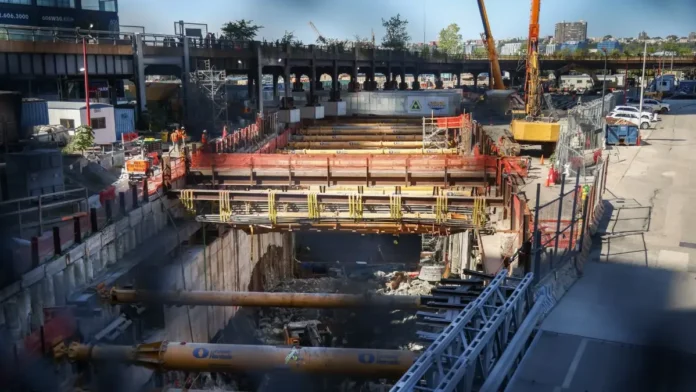

With billions in federal funding frozen, state leaders call the halt politically driven and vow legal action to protect jobs, commuters, and the region’s transportation future
New Jersey’s largest and most consequential transportation project is now at the center of a rapidly escalating legal and political confrontation, as state officials warn that active construction on the $16 billion Gateway rail tunnel could grind to a halt as early as February 6 if frozen federal funding is not released.
Governor Mikie Sherrill, joined by acting Attorney General Jennifer Davenport, delivered a blunt message during a press conference in Newark this week: the suspension of federal funds threatens not only one of the nation’s most important rail infrastructure projects, but also thousands of jobs and the daily commute of hundreds of thousands of New Jersey and New York residents.
The Gateway Tunnel project, designed to construct a new Hudson River rail tunnel and rehabilitate the existing century-old infrastructure linking New Jersey to Manhattan, is widely regarded as the backbone of the Northeast Corridor. The corridor carries the highest volume of passenger rail traffic in the United States and is essential to the economic stability of the entire Northeast megaregion.
According to state officials and the Gateway Development Commission, the project is now facing an operational cliff. Construction activity is being scaled down as contractors prepare for the possibility that funding will remain inaccessible. Project leadership has warned that without immediate access to federal dollars already committed to the project, work must stop within days.
Governor Sherrill described the funding freeze as a deliberate political act rather than an administrative or compliance issue.
She said the project carries deep personal and regional significance, noting that her own family depends on reliable trans-Hudson rail service. She warned that the loss of momentum on Gateway would reverse years of planning and investment meant to finally deliver a modern, dependable one-seat ride into New York City for New Jersey commuters.
Sherrill said she raised the issue directly with President Donald Trump in recent days and underscored the broader implications of the decision.
She characterized the freeze as the cancellation of funding that had already been approved, appropriated, and prepared for deployment, and said New Jersey is now using every legal tool available to keep the funding pipeline open, workers on the job, and the project moving forward.
Standing beside the governor, acting Attorney General Jennifer Davenport said the state’s legal case is straightforward.
New Jersey and New York jointly filed a lawsuit in the U.S. District Court for the Southern District of New York on February 3, seeking to compel the U.S. Department of Transportation to restore the suspended funding. The filing asserts that the federal government is unlawfully withholding billions of dollars owed to the Gateway project and violating statutory and administrative requirements governing federal transportation grants.
The lawsuit followed a separate action filed one day earlier by the Gateway Development Commission itself. In that case, the commission’s project manager alleges breach of contract and warns that the funding freeze makes it impossible to continue construction operations under existing agreements.
Davenport said the funding pause, which has been in place since October, violates federal law in multiple ways and fails to meet basic requirements that agencies must provide valid, lawful reasons for major funding decisions.
She further alleged that the suspension reflects an improper attempt to punish political rivals by targeting a critical regional infrastructure investment, adding that public statements by the president describing the project as “terminated” support the claim that the freeze is politically motivated.
Davenport thanked New York officials for their partnership in the litigation and said both states are united in demanding that the federal government immediately reverse course.
Governor Sherrill echoed that position, saying there is no credible explanation for the prolonged delay other than what she described as political maneuvering and shifting justifications.
She pointed to statements made by the president criticizing Democratic leadership and linking that criticism to the decision to withhold funding, arguing that the remarks make clear the true motive behind the freeze.
Sherrill said the state will continue pursuing both legal action and federal advocacy, emphasizing that members of New Jersey’s congressional delegation are actively negotiating to unlock the funds and avoid a shutdown that would ripple across the region’s economy.
Among those leading that effort is U.S. Representative Josh Gottheimer of New Jersey’s 5th Congressional District, who held a separate media call to outline what he described as a bipartisan push among New Jersey and New York lawmakers to resolve the impasse.
Gottheimer said the legal challenges are necessary but not sufficient on their own. He stressed that negotiations must continue in parallel, warning that the consequences of allowing the project to stall are far too severe for both states and the nation’s transportation system.
He said lawmakers from both parties are attempting to bring all sides back to the table to protect years of planning, bipartisan commitments, and construction progress that is already underway.
Gottheimer described himself as baffled by the administration’s decision to jeopardize a project with such clear economic, public safety, and workforce benefits. He said he sees no rational policy basis for the freeze and suggested that politics appears to be the primary driver behind the decision.
He added that the Gateway project supports thousands of union construction jobs, engineering positions, and professional services roles across the region, and that a shutdown would immediately impact families, small businesses, and contractors who rely on the steady flow of work generated by the project.
The Trump administration has cited concerns related to the project’s Disadvantaged Business Enterprise program as the basis for freezing funds. However, New Jersey officials and congressional leaders argue that the issue could have been addressed through standard compliance processes rather than a sweeping suspension of federal support.
Gottheimer said the explanation does not align with the scale of the action taken and argued that regulatory questions should never be used to derail a nationally significant infrastructure program.
Beyond the courtroom and Capitol Hill, the looming shutdown has triggered growing concern among regional planners, labor organizations, and business leaders who view Gateway as foundational to the long-term competitiveness of the New York–New Jersey metropolitan area.
The new tunnel is designed to eliminate one of the most severe bottlenecks in the national rail network, reduce cascading delays throughout the Northeast Corridor, and provide redundancy in the event of system failures affecting the existing Hudson River tunnels, which were heavily damaged during Superstorm Sandy.
Transportation economists have repeatedly warned that a prolonged failure of the current tunnels—without the Gateway replacement in place—could cut trans-Hudson rail capacity by as much as 75 percent, severely restricting access to Manhattan’s employment centers and triggering far-reaching economic losses throughout northern New Jersey.
With contractors now preparing contingency plans and live construction activity under threat, the Gateway Tunnel has become an urgent test case for how large-scale infrastructure programs are protected from political disruption.
State officials say the outcome will shape not only the future of this project, but also investor and contractor confidence in federally supported transportation initiatives nationwide.
As legal filings proceed and negotiations continue, New Jersey leaders insist they will not allow the project to collapse under what they describe as an unlawful funding freeze, warning that the region cannot afford to lose momentum on a project that is central to both economic growth and public mobility.
Continued coverage of the Gateway Tunnel and other large-scale transportation and infrastructure initiatives will remain a major focus of Sunset Daily News’ regional construction reporting across New Jersey and the greater metropolitan corridor.



