



New leadership, enterprise integrations and automation-driven sourcing position New Jersey firm at the center of a rapidly shifting corporate housing market
A growing shortage of flexible, high-quality corporate housing is reshaping how major employers, insurers and relocation firms move talent across the country—and a Princeton-based technology company is emerging as one of the most closely watched solutions in that market.
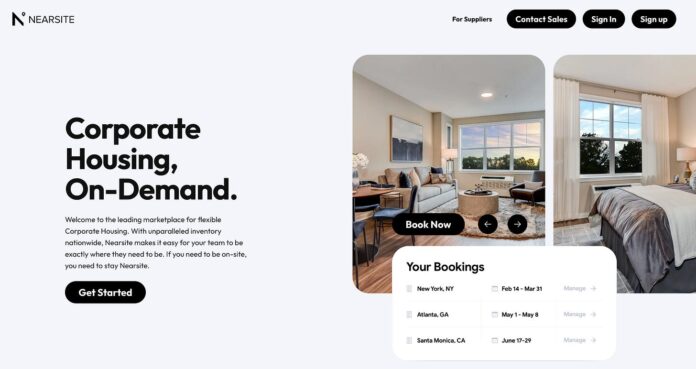
As of early 2026, Nearsite is scaling its AI Copilot platform to meet surging demand for furnished, short-term housing for enterprise workforces, catastrophe response teams and large-scale infrastructure projects. The company’s technology-driven model is designed to replace the fragmented, manual housing procurement process that has dominated corporate relocations for decades.
Nearsite’s approach has quickly drawn attention across the national business landscape, where rising rental costs, limited inventory and unpredictable staffing cycles have made temporary housing one of the most complex operational challenges facing large organizations.
The platform is built around a predictive workforce intelligence layer that converts project timelines and staffing forecasts into concrete housing demand months before employees are deployed.
For industries such as data center construction, life sciences expansion, infrastructure modernization and large commercial buildouts, workforce size can swing dramatically between planning, engineering, installation and commissioning phases. Nearsite’s AI models translate those shifting headcounts into forward-looking housing needs, allowing employers to secure appropriate inventory well ahead of peak demand.
Company leaders say this predictive workforce mapping is particularly valuable for capital-intensive projects where delays in housing availability can directly affect labor availability and construction schedules.
The second major engine inside the platform is Nearsite’s automated sourcing marketplace.
Instead of relying on broker-driven spreadsheets, disconnected vendor lists and manual RFP cycles, Nearsite uses an AI-powered inventory engine to surface vetted, furnished properties in real time. The system evaluates location, quality standards, availability windows, lease terms and proximity to job sites or corporate offices.
This capability becomes especially critical during sudden workforce surges, such as disaster recovery operations and insurance catastrophe deployments. During peak CAT season, adjuster and inspection teams often need housing in large volumes within days. Nearsite’s platform is designed to respond to those spikes in demand without the bottlenecks typically associated with short-term housing procurement.
A defining feature of Nearsite’s model is its direct-to-doorstep sourcing structure.
By bypassing traditional intermediaries and negotiating directly with property owners and operators, the company reports that clients can reduce overall housing costs by approximately 20 to 30 percent. For enterprises managing thousands of short-term placements annually, those savings translate into meaningful reductions in operating expense at a time when urban and suburban rental markets remain highly competitive.
Equally important for corporate real estate and human resources teams is budget transparency. Nearsite’s contract structure allows decision-makers to track unit-level pricing, location premiums and length-of-stay costs in real time—helping companies maintain financial control as deployment volumes fluctuate.
The platform also reflects a broader shift toward what Nearsite describes as a human-centric mobility ecosystem.
Rather than focusing solely on proximity to job sites, the AI layer incorporates lifestyle and retention factors into housing recommendations. The system prioritizes access to schools, parks, public transportation and essential services, aligning housing placement with employee well-being and long-term retention strategies—an increasingly important consideration in a hybrid and mobile workforce environment.
Nearsite positions this approach as a response to what many corporate planners now describe as a geographic mismatch between where talent lives and where projects or offices are located.
In 2026, corporate housing demand is increasingly concentrated in dense urban centers and fast-growing technology corridors, driven by return-to-office initiatives, AI infrastructure development and large-scale digital transformation projects. Rather than relying on new construction, Nearsite’s platform mobilizes existing residential inventory to rapidly absorb demand spikes without waiting for additional housing supply to come online.
The company’s expansion strategy received an additional boost with the appointment of industry veteran Jacq Johnson as Senior Director, tasked with scaling North American sales and enterprise partnerships.
Johnson brings deep experience across corporate housing, workforce mobility and enterprise services, and will lead Nearsite’s efforts to expand relationships with Fortune 1000 employers, national insurers and relocation providers. Company leadership says the appointment reflects a strategic push to align enterprise sales with the platform’s rapidly expanding technical capabilities.
Behind the scenes, Nearsite operates on a SaaS-plus-transaction pricing model designed specifically for high-volume corporate users.
Enterprises subscribe to the AI Copilot platform for workforce forecasting, automated sourcing and operational analytics. Transactional sourcing fees are embedded directly into housing agreements with property partners. Nearsite says this structure is intentionally designed to be cost-neutral by offsetting platform costs with the savings generated through direct-to-landlord sourcing and reduced broker involvement.
From a systems perspective, Nearsite’s technology has been built to integrate directly into enterprise human resources workflows.
The platform synchronizes with leading Human Resource Information Systems, including Workday and SAP SuccessFactors. When a new project assignment, relocation event or temporary deployment is created within a company’s HR system, Nearsite’s automation layer can immediately initiate a housing search for the affected employees.
This integration removes the lag between workforce planning and housing procurement, allowing mobility teams to operate as an extension of HR operations rather than a downstream administrative function.
Nearsite’s growth in New Jersey is unfolding alongside parallel expansion by other AI-driven service providers in the state’s digital economy.
Edison-based Zuztec Media, for example, is scaling modular AI marketing and commerce infrastructure that complements workforce and housing platforms through predictive analytics, automation and enterprise integrations. While the two companies operate in different segments, both reflect a broader trend toward platform-driven operational efficiency across corporate services.
Zuztec Media’s modular pricing model allows enterprise clients to adopt individual AI engines—such as predictive analytics or automated customer support—without committing to full agency retainers. Its marketplace integrations feed AI-generated content and dynamic pricing into Shopify and Amazon systems through direct administrative connections, supporting rapid go-to-market execution for growing brands.
Together, Nearsite in Princeton and Zuztec Media in Edison illustrate how New Jersey is becoming an increasingly strategic base for applied artificial intelligence platforms that solve real operational bottlenecks for national enterprises.
For corporate leaders navigating workforce mobility in 2026, the message is becoming clear.
As housing availability tightens, projects scale faster and employee expectations evolve, the ability to predict demand, automate sourcing and integrate mobility directly into HR systems is no longer a competitive advantage—it is becoming a baseline requirement.
With its AI Copilot platform, direct-sourcing marketplace and newly expanded North American leadership, Nearsite is positioning New Jersey at the center of a new generation of enterprise housing infrastructure—one built for speed, transparency and a workforce that is more mobile than ever before.



