



National launch draws major corporate backing and philanthropy as a new child-focused investment account aims to reshape how American families build long-term financial security
A newly created federal investment program designed to give children an early foothold in the financial system officially debuted this week, drawing attention from national business leaders, financial institutions, and economic advocacy organizations across the country — including strong public support from the United States Hispanic Business Council.
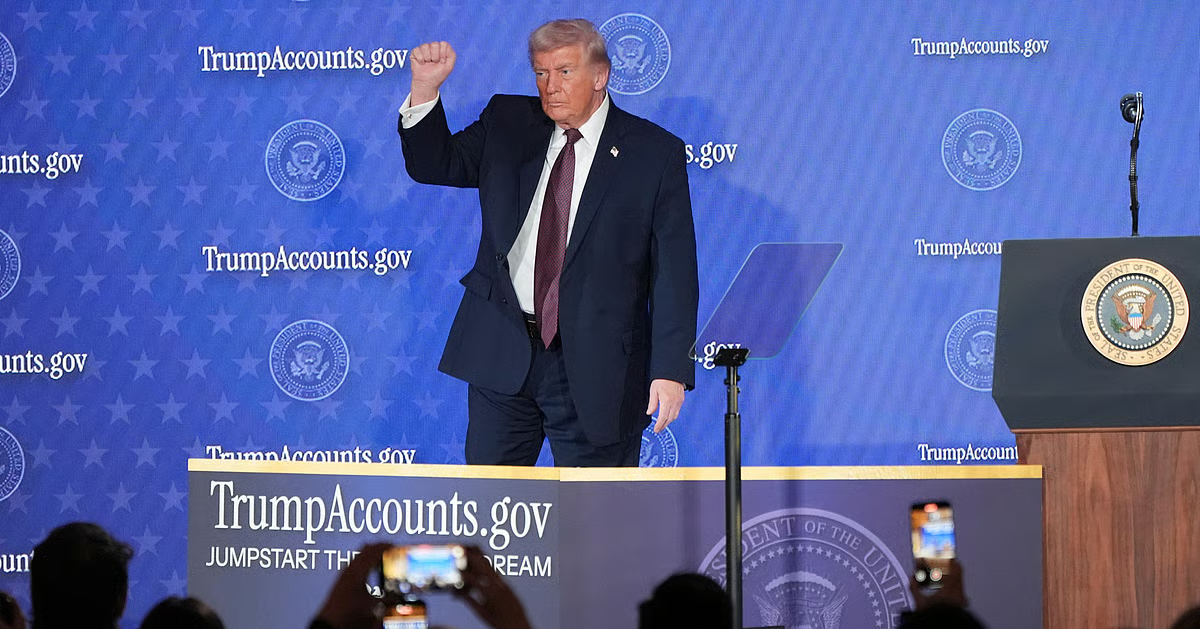
At a high-profile launch event held January 28, President Donald Trump joined elected officials and private-sector executives to formally introduce what are being called “Trump Accounts,” a new form of federally authorized, tax-deferred investment account for minors.
The initiative is already being closely followed across the financial and small-business community, particularly by organizations monitoring long-term workforce development and family wealth creation through the broader national business landscape.
Javier Palomarez, President and Chief Executive Officer of the United States Hispanic Business Council, attended the launch and publicly endorsed the program, describing it as a practical step toward restoring economic mobility for working families and expanding ownership opportunities for the next generation.
Trump Accounts were created through federal legislation enacted in 2025 and are structured as custodial, tax-deferred retirement-style accounts specifically built for children. The accounts are intended to introduce young Americans to long-term investing while establishing an early foundation for savings that can be carried into adulthood.
Under the program’s framework, the U.S. Treasury will make a one-time $1,000 deposit for every eligible child born between January 1, 2025 and December 31, 2028. That initial seed contribution is designed to ensure that families of all income levels — including households with limited access to traditional investment tools — can participate from the outset.
In addition to the federal seed deposit, families and supporters may contribute up to $5,000 per year into each account. Contributions may be made by parents, grandparents, relatives, employers, nonprofit organizations, and approved charitable partners.
The accounts are required to be invested in low-cost, diversified investment products, including mutual funds and exchange-traded funds that track major U.S. stock market indexes. The investment structure is intended to keep fees low, minimize risk concentration, and emphasize long-term market growth rather than speculative trading.
Unlike conventional youth savings plans, Trump Accounts are structured to remain locked until the account holder reaches age 18. At that point, the account transitions into a traditional individual retirement account framework. Funds can then be used for qualified purposes such as higher education, first-time homeownership, or entrepreneurial ventures, while maintaining the tax advantages associated with retirement-style investment vehicles.
Federal officials involved in the program say the goal is to normalize early financial participation and introduce compound growth into family planning far earlier than most Americans currently experience.
The January 28 launch event brought together political leaders and executives from across banking, technology, and transportation sectors. Several major corporations announced voluntary private-sector participation by committing to match the federal seed contribution for children of eligible employees.
Among the companies pledging support were JPMorgan Chase, Bank of America, Intel, and Uber. Each organization indicated that matching programs would be implemented internally as part of employee benefit initiatives tied to family financial security and workforce retention.
In addition to corporate matching programs, one of the most significant private commitments came from philanthropists Michael and Susan Dell, who announced a $6.25 billion donation connected to the initiative. Their contribution is intended to provide an additional $250 in starter funding for as many as 25 million children age ten and under who live in lower-income communities.
Economic development groups say that scale of private investment signals an unusual level of confidence from both corporate leadership and philanthropic institutions in the long-term potential of the program.
Palomarez, speaking on behalf of the United States Hispanic Business Council, said the organization views Trump Accounts as a market-driven approach to addressing generational wealth gaps while reinforcing the value of private ownership and early access to capital.
In his public statement, Palomarez described the initiative as a meaningful move toward rebuilding upward mobility for American families, particularly those who historically have had limited access to investment vehicles, employer-sponsored retirement plans, and intergenerational financial support.
The USHBC has long focused on small-business growth, workforce development, and capital access for Hispanic entrepreneurs and family-owned enterprises. Council leadership emphasized that the ability to introduce children to investment markets early — while also connecting those accounts to future education and business formation — aligns with broader efforts to expand entrepreneurship and private-sector participation nationwide.
Program administrators say enrollment for Trump Accounts will be handled directly through the Internal Revenue Service. Parents and legal guardians will be able to register children either by submitting IRS Form 4547 or through a new federal online enrollment platform scheduled to launch in the summer of 2026.
Once opened, accounts will be administered through approved financial institutions participating in the program.
Financial planners caution that while the accounts function similarly to traditional retirement vehicles, families should treat them as long-term assets rather than short-term savings tools. The design is intentionally structured to encourage decades-long growth rather than immediate withdrawals, reinforcing the broader policy goal of sustained financial participation.
Across New Jersey, financial advisors and employer groups are already beginning to evaluate how the new accounts may fit into existing benefits programs, education planning strategies, and workforce retention initiatives, especially as several large national employers with major New Jersey operations have committed to employee matching programs.
As implementation moves forward, the combination of federal funding, private-sector matches, and large-scale philanthropic contributions positions Trump Accounts as one of the most ambitious youth-focused financial initiatives introduced in decades — and one that could significantly reshape how American families approach saving, investing, and long-term economic stability.