


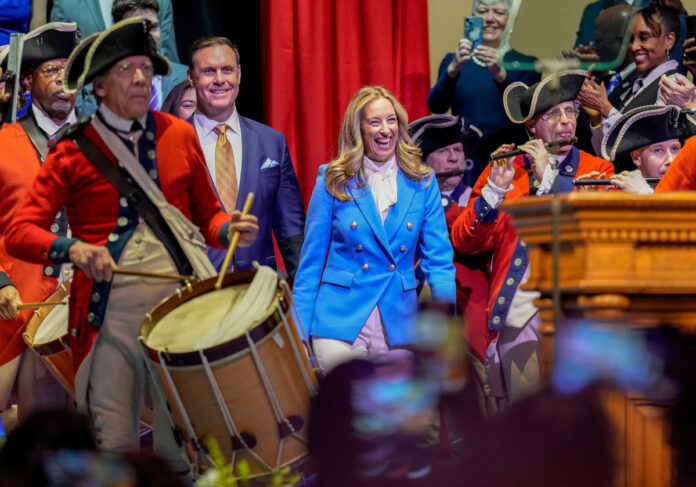

New Jersey formally entered a new political era Tuesday as Democrat Mikie Sherrill was sworn in as the state’s 57th governor during a high-profile inauguration ceremony in Newark. The event marked both a historic milestone and a clear signal that the new administration intends to move quickly on economic and energy priorities that defined the recent election.
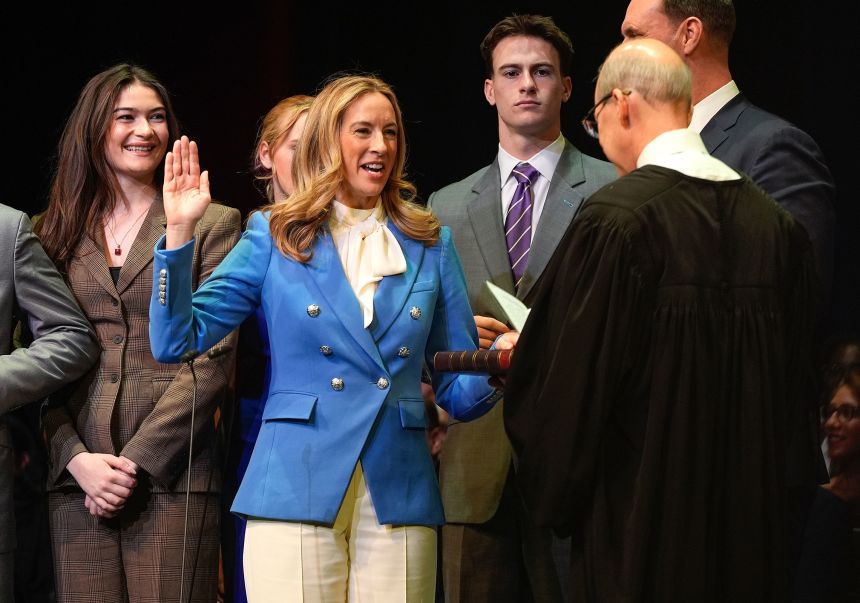
Sherrill, a four-term member of Congress and former Navy helicopter pilot, assumes leadership of a state of nearly 9.5 million residents as only the second woman ever elected governor. Her victory also broke long-standing political precedent, making her the first major-party candidate in more than 60 years to secure a third consecutive Democratic term in New Jersey’s top office, following two terms served by outgoing Governor Phil Murphy.
The inauguration reflected both symbolism and urgency. Sherrill took the oath of office on a historic copy of the U.S. Constitution once owned by New Jersey’s first governor, underscoring a theme that would define her remarks: a call for constitutional balance, accountability, and public service rooted in history. Holding the ceremony in Newark, the state’s largest city, further highlighted the coalition that powered her statewide victory, particularly strong urban turnout that proved decisive in November.
During her inaugural address, Sherrill wasted no time outlining her priorities. She formally signed an executive order freezing utility rates, fulfilling a central campaign promise aimed at addressing rising household costs. A second executive action launched efforts to expand electricity generation across the state, including investments in solar and nuclear energy, positioning New Jersey to confront both affordability and long-term energy reliability.
Sherrill framed her administration as a counterweight to national policies she argued are driving up costs for families. Drawing on Revolutionary War history and the language of the Declaration of Independence, she drew pointed contrasts between New Jersey’s approach to governance and what she described as an erosion of constitutional norms at the federal level.
“We see a president illegally usurping power,” Sherrill said during her address. “He has unconstitutionally enacted a tariff regime that raises costs for working families. Here in New Jersey, we demand that people in public service actually serve the public.”
Her remarks reflected how she cast the campaign, presenting her election as a rejection of former President Donald Trump’s political vision. Sherrill defeated a Trump-endorsed Republican opponent by focusing on cost-of-living pressures, utility bills, and economic fairness, themes that resonated across suburban, urban, and working-class communities.
The ceremony itself departed from past traditions centered solely in Trenton. While it included military elements such as a ceremonial gun salute and a helicopter flyover, the choice of Newark signaled a more outward-facing and inclusive tone. It also placed the inauguration within a broader national context, as Sherrill’s former congressional colleague Abigail Spanberger was sworn in the same day as governor of Virginia following a similarly decisive victory.
Sherrill inherits a state shaped by eight years of Murphy’s leadership. During his tenure, New Jersey enacted a series of progressive policies, including higher taxes on millionaires, a phased increase in the minimum wage, expanded access to early childhood education, and long-overdue full funding of public employee pensions. Murphy departs office having largely delivered on his campaign promises, but he also leaves behind a significantly larger state budget and unresolved questions about long-term fiscal sustainability.
In his final days in office, Murphy described the transition as collaborative and deliberate, noting that he and Sherrill remained in close contact throughout the process. He emphasized that his administration governed according to its stated principles, even as the size and scope of government expanded.
Sherrill now takes office with a Democratic-controlled legislature, giving her administration a clear governing runway but also heightened expectations. New Jersey is one of more than a dozen states where one party controls both the executive and legislative branches, placing added focus on how effectively leadership converts political alignment into policy results.
The moment also invites reflection on the state’s political history. While New Jersey has often alternated parties in the governor’s office, extended one-party control has been rare. The last time voters handed the same party a third consecutive gubernatorial win was in 1961, underscoring the significance of Sherrill’s victory and the trust placed in her leadership.
As Sherrill begins her term, attention will turn quickly to how her early executive actions translate into measurable relief for residents and how her administration navigates the complex intersection of state governance and national politics. With costs, energy, and constitutional principles at the center of her opening message, the new governor has made clear that her administration intends to lead assertively from day one.



