


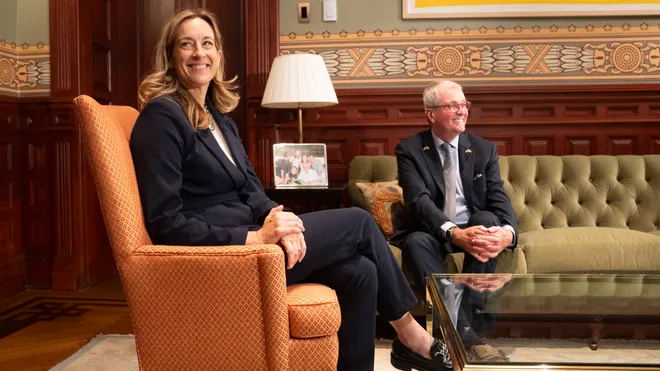

New Jersey enters 2026 at a moment of profound political transition, marked by the closing chapter of Governor Phil Murphy’s eight-year administration and the imminent inauguration of Governor-elect Mikie Sherrill. Today stands as one of Murphy’s final days in office; tomorrow, the state is set to swear in its first female governor, a milestone that carries both symbolic weight and immediate governing consequences.
Murphy leaves office having signed a slate of consequential legislation in his final weeks. Among the most significant is an expansion of paid family leave that extends coverage to employees at companies with as few as 15 workers, broadening protections for thousands across the state. He also approved new health policy legislation establishing that New Jersey’s own public health guidance—not solely federal recommendations—will determine vaccine requirements and insurance coverage, reinforcing the state’s authority over healthcare standards.
The start of the new year has already brought tangible changes for residents. As of January 1, the minimum wage rose again, reaching $15.92 per hour for most workers, continuing the state’s long-term wage escalation plan. Drivers are feeling the impact as well, with a 4.2-cent-per-gallon increase in the gas tax and higher tolls now in effect on the New Jersey Turnpike, Garden State Parkway, and major Delaware River crossings. These cost-of-living adjustments arrive as policymakers prepare for what many expect to be a challenging fiscal environment.
Structural changes within state government are also underway. A newly established, cabinet-level Department of Veterans Affairs began operations this month, consolidating services and signaling a renewed focus on veterans’ issues. Murphy highlighted that move, along with other achievements, during his final State of the State address, even as Governor-elect Sherrill has been candid about looming fiscal pressures she has described as “budget time bombs” awaiting the next administration.
While attention has largely centered on Trenton’s leadership shift, tensions at the federal level continue to reverberate through New Jersey. Outgoing Attorney General Matthew Platkin has been the subject of anonymous, well-funded attack mailers in communities such as Princeton and Westfield, despite not being a declared candidate for any office. The appearance of these so-called dark money campaigns has raised fresh concerns about transparency and accountability in the broader political climate.
Those concerns have been amplified by ongoing controversies surrounding immigration enforcement. A newly introduced bill in the state legislature would require body cameras for all Immigration and Customs Enforcement agents operating within New Jersey, reflecting growing scrutiny of federal actions inside the state. The issue has gained urgency following the death of 41-year-old Jean Wilson Brutus at the Delaney Hall detention facility, just one day after he was taken into ICE custody. Family members have publicly questioned the circumstances surrounding his death, saying he had no known medical issues prior to his detention.
The case has intersected with the legal battle facing U.S. Representative LaMonica McIver of Newark, who remains under federal charges stemming from a lawful congressional oversight visit to the same facility last year. McIver has forcefully denied wrongdoing, characterizing the prosecution as an attempt to intimidate elected officials and suppress oversight. Although hopes for swift judicial relief dimmed earlier this month when the Third Circuit declined to dismiss the case, supporters continue to press for her full exoneration amid growing national debate over ICE authority and accountability.
Against this backdrop, New Jersey is gearing up for a politically active year. The formation of a new gubernatorial administration, local and legislative races, and several high-stakes congressional contests promise to keep the state at the center of national attention. Voters here have historically played an outsized role in shaping broader political narratives, and 2026 appears poised to be no exception.
As power changes hands in Trenton, the direction of the state will be shaped not only by new leadership but by how firmly New Jersey asserts its values amid federal uncertainty. The coming months will test institutions, laws, and political resolve, with implications that extend well beyond state borders. Ongoing coverage and analysis of these developments will continue across Sunset Daily News’ reporting on state and national politics, as the Garden State once again steps into a consequential moment in its civic life.



