


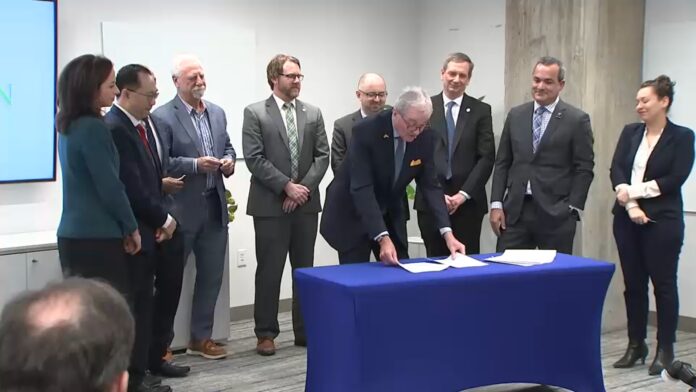

Outgoing Governor Phil Murphy Marks Final Press Event With $25 Million Investment in Statewide AI Initiative. New Jersey took a decisive step into the future of technology as outgoing Governor Phil Murphy hosted his final press event on January 16 at the Gateway Center in Newark, signing a landmark Memorandum of Understanding with tech giant Nvidia and the state’s universities. The collaboration establishes a comprehensive framework connecting higher education, workforce development, and advanced research in artificial intelligence, including generative AI, while supporting economic growth across the state.
The agreement also comes with a $25 million commitment from the state to fund a statewide AI supercomputer initiative, positioning New Jersey as a leader in next-generation computing infrastructure. Murphy described the announcement as the “last major initiative” of his eight-year administration and a capstone to his efforts to transform New Jersey into a hub for innovation, research, and technology-driven workforce development.
“This initiative brings together New Jersey’s universities, our public sector, and one of the most formidable companies on the planet – Nvidia – to shape the future of AI and create opportunities for our students, workers, and entrepreneurs,” Murphy said. “It’s a fitting conclusion to eight years of work focused on ensuring New Jersey remains at the forefront of technological innovation and economic opportunity.”
The MOU creates an integrated AI ecosystem across the state, connecting the NJ AI Hub, research universities, community colleges, and public sector agencies. Officials emphasized that this collaboration will enhance AI research capabilities, expand training and educational programs, and generate long-term economic benefits for residents. Murphy noted that the initiative reflects a sustained effort by his administration to position New Jersey as a global destination for innovation while preparing the next generation of workers for careers in technology.
Murphy’s final days in office coincide with several other major policy actions. Among his recent legislative achievements, he signed a bill banning student cellphone use in schools, effective for the 2026–2027 academic year, and oversaw a rise in the state’s minimum wage to $15.92 per hour beginning January 1, 2026. The administration also moved to take full control of the Lakewood school district, addressing long-standing governance and financial challenges. Additionally, a trio of immigrant protection bills remains pending signature as the state continues to respond to ongoing ICE enforcement actions.
In reflecting on his tenure, Murphy described his final press event as both celebratory and bittersweet. “Four days to go, and you feel the weight of all that has passed,” he told reporters. “This is the last press avail, the last major announcement. It’s emotional, but it’s also about celebrating what we’ve accomplished together for the people of New Jersey.”
Governor-elect Mikie Sherrill is set to take the oath of office on January 20, continuing the state’s leadership amid ongoing policy initiatives and a rapidly evolving economic and technological landscape. Murphy’s AI partnership, alongside his recent legislative actions, leaves a substantial imprint on New Jersey’s strategic trajectory in innovation, education, and workforce readiness.
As the state prepares for the transition, the Nvidia collaboration underscores a commitment to bridging cutting-edge technology with public service and education, ensuring that New Jersey remains a competitive force in the global AI and tech economy. For updates on state initiatives and technology developments, New Jersey residents and business leaders can follow the latest politics coverage to stay informed on how the transition may impact ongoing projects and investments.
Murphy Administration Moves to Close Old Emergencies, Advance Plastic Reform, and Reinforce Civil Rights Protections. New Jersey state government took action on multiple fronts Friday, formally closing the door on years-old emergency declarations, advancing new environmental legislation, and issuing updated civil rights guidance aimed at strengthening protections against discrimination statewide.
Governor Phil Murphy signed an executive order terminating several states of emergency that have remained in effect for more than a decade. Some of the declarations dated back to Hurricane Irene in 2011 and Superstorm Sandy in 2012, events that reshaped large portions of the state and required extraordinary executive authority at the time. Administration officials said the move reflects New Jersey’s full transition out of long-term recovery mode and restores normal statutory governance where emergency powers were no longer necessary.
The governor’s office emphasized that ending the declarations does not undo any permanent laws, funding programs, or rebuilding efforts that resulted from those emergencies. Instead, the order cleans up legacy actions that had remained on the books well beyond their practical use, signaling a shift toward administrative clarity and closure as the state continues to prepare for future climate and infrastructure challenges.
At the State House, lawmakers advanced new legislation aimed at curbing plastic waste across New Jersey. The bill, approved by the Senate, would require food service establishments to provide single-use utensils, napkins, and condiment packets only when requested by customers, rather than automatically including them with takeout and delivery orders. Supporters argue the measure would significantly reduce unnecessary plastic consumption while aligning with the state’s broader environmental goals.
Environmental advocates and bill sponsors cited the success of similar policies in other states, noting reductions in plastic waste and cost savings for businesses over time. Opponents raised concerns about customer convenience and implementation, but proponents countered that the bill preserves consumer choice while addressing mounting environmental pressures. The measure now moves forward in the legislative process for further consideration.
In a separate action, Attorney General Matthew Platkin issued new statewide guidance clarifying that discrimination based on language, accent, or manner of speech is prohibited under the New Jersey Law Against Discrimination. The guidance applies to housing, employment, and places of public accommodation, reinforcing that unequal treatment tied to how someone speaks or the language they use is a civil rights violation.
Platkin’s office said the guidance was intended to eliminate ambiguity and ensure consistent enforcement, particularly in communities with large immigrant and multilingual populations. The clarification comes amid increased attention to equity and access issues across the state and reflects New Jersey’s long-standing reputation for having some of the strongest civil rights protections in the country.
Together, the actions reflect a busy day in Trenton, touching on governance, environmental responsibility, and civil rights enforcement. As these developments unfold, they are expected to remain central topics within New Jersey’s broader political landscape, shaping ongoing discussions in state politics and policy-making in the months ahead.



