


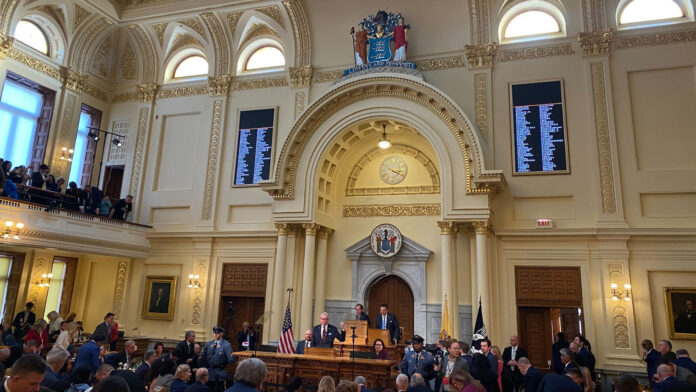

Outgoing Governor Phil Murphy delivered his final State of the State address this week, offering a comprehensive reflection on eight years of leadership and a forward-looking vision for New Jersey’s continued growth. Speaking to lawmakers, community leaders, and business executives, Murphy highlighted achievements across economic development, tax reform, social programs, and infrastructure investments, framing his tenure as a period of meaningful transformation for the Garden State.
A central theme of Murphy’s address was economic expansion. He pointed to initiatives designed to create jobs, attract new industries, and support small businesses as foundational to the state’s economic resilience. Murphy emphasized efforts to modernize workforce development programs, aiming to equip residents with skills for emerging sectors while keeping New Jersey competitive in a fast-evolving national economy. This focus on economic opportunity extended to measures designed to ease property tax burdens, which the governor framed as critical to supporting families, encouraging homeownership, and strengthening local communities.
Infrastructure and public services were also key pillars of the speech. Murphy highlighted investments in transportation, healthcare, and education, describing them as essential components of a state prepared for long-term growth. From expanding public transit options to funding school improvements and healthcare access initiatives, the governor presented a vision of a New Jersey that balances economic progress with quality of life for residents.
Business leaders have consistently noted the administration’s approach to public-private collaboration. Murphy underscored policies that incentivize innovation and entrepreneurship, including tax credits, grants for small businesses, and programs encouraging technological development. These strategies, he argued, have positioned New Jersey as a state where businesses can thrive while communities benefit from sustainable economic growth. Observers from the [Business] sector have highlighted these programs as pivotal in fostering a climate of investment and opportunity.
The governor also addressed challenges faced during his tenure, from economic disruptions to public health crises, portraying them as moments that tested and ultimately strengthened the state. He emphasized that New Jersey’s achievements were rooted in partnership: between government and industry, among lawmakers across party lines, and with residents who have engaged in shaping their communities. This collaborative approach, he suggested, is key to addressing ongoing issues such as equitable development, climate resilience, and social inclusion.
Murphy concluded his address by framing his legacy around a commitment to fairness, opportunity, and long-term planning. While looking back on successes, he encouraged continued attention to policies that foster economic mobility, improve public services, and support local communities. Lawmakers, civic leaders, and residents now face the task of building on these initiatives, ensuring that the state remains poised for sustainable growth in the years ahead.
From job creation to property tax reform, from infrastructure investment to business support programs, Murphy’s final address offers a detailed roadmap of the priorities that have shaped New Jersey’s recent progress. For anyone following economic policy and community development in the state, the speech underscores the importance of strategic planning, collaborative governance, and continued engagement from both public and private sectors to drive the Garden State forward.
A Valedictory Moment in Trenton Signals a Political Passing of the Torch. Phil Murphy delivered what amounted to a political valedictory on Tuesday, marking his final State of the State address with a reflective, personal, and at times pointed message to the residents of the state he has governed for two terms. The Massachusetts native, long since adopted by New Jersey, used the moment to both recount his personal journey and define the legacy he believes his administration leaves behind.
Murphy opened with stories from his childhood, sketching a portrait of modest beginnings. He recalled growing up in a small home and sharing his parents’ bedroom until nearly his teenage years, as well as landing his first job as a dishwasher at age 13. These anecdotes were not simply nostalgic—they were used to reinforce the philosophy that has shaped his tenure: building a New Jersey he repeatedly described as “stronger and fairer.”
That guiding principle, which he often refers to as his “north star,” framed a long list of policy milestones he credited with improving everyday life across the state. Among the measures he highlighted were the gradual doubling of the minimum wage to nearly $16 an hour, new tax structures designed to draw more revenue from the state’s wealthiest residents, a sustained decline in violent crime and incarceration rates, major increases in school funding, and the rollout of property tax relief initiatives such as the Anchor program.
Collectively, the agenda underscored Murphy’s progressive priorities, yet the governor made a visible effort to cast his administration as one willing to work across the aisle. He invoked both Ronald Reagan and John F. Kennedy, urging policymakers to focus less on partisan labels and more on what he characterized as the “right answers.” Murphy also reminded the audience that his governorship has spanned two Trump administrations and one Biden administration, emphasizing that he has sought cooperation with leaders of both parties whenever New Jersey’s interests were at stake.
Still, the governor did not shy away from drawing lines. He pointed to legal battles with the federal government, particularly during the Trump years, and reiterated his administration’s strong stance in support of immigrant communities—remarks that drew some of the loudest applause in a Legislature now firmly dominated by Democrats.
Looking ahead, Murphy struck an optimistic tone about the state’s economic and cultural trajectory. He highlighted New Jersey’s growing presence in artificial intelligence research and development, arguing that emerging technologies can serve as a unifying force rather than a disruptive one. He also celebrated the construction of three major film and television studios, noting that Netflix, Lionsgate, and Paramount have all committed to establishing a permanent footprint in the Garden State, reinforcing New Jersey’s expanding role in the entertainment economy.
The governor also took a moment to lean into his reputation as a sports enthusiast, especially when discussing soccer. He praised New Jersey’s selection as host of the 2026 World Cup championship match at MetLife Stadium, calling the global event an opportunity to showcase the state as a welcoming hub for innovation, culture, and international exchange. He even offered a precise kickoff date and time for the tournament’s opening match in East Rutherford.
Throughout the address, Murphy paused to honor public servants, staff members, and former leaders who have passed away, including former Governor Dick Codey. The acknowledgments lent a ceremonial tone to a speech that increasingly felt like a closing chapter.
As he neared the end of his remarks, Murphy turned his attention to what comes next. He assured residents that New Jersey’s leadership future is secure, pointing directly to Representative Mikie Sherrill as the figure he believes is prepared to step into a defining role. In a moment that drew murmurs and laughter, he described her as a “superhero waiting in the wings,” effectively signaling his confidence in her political ascent.
The comment may have been delivered lightly, but its implications were unmistakable. With his departure approaching, Murphy used his final address not only to recount what he views as eight years of progress, but also to shape the narrative of succession—one that places Sherrill at the center of New Jersey’s next political chapter, in a state where power, policy, and the future of government remain central to ongoing public conversation within the broader sphere of Business and governance.



